
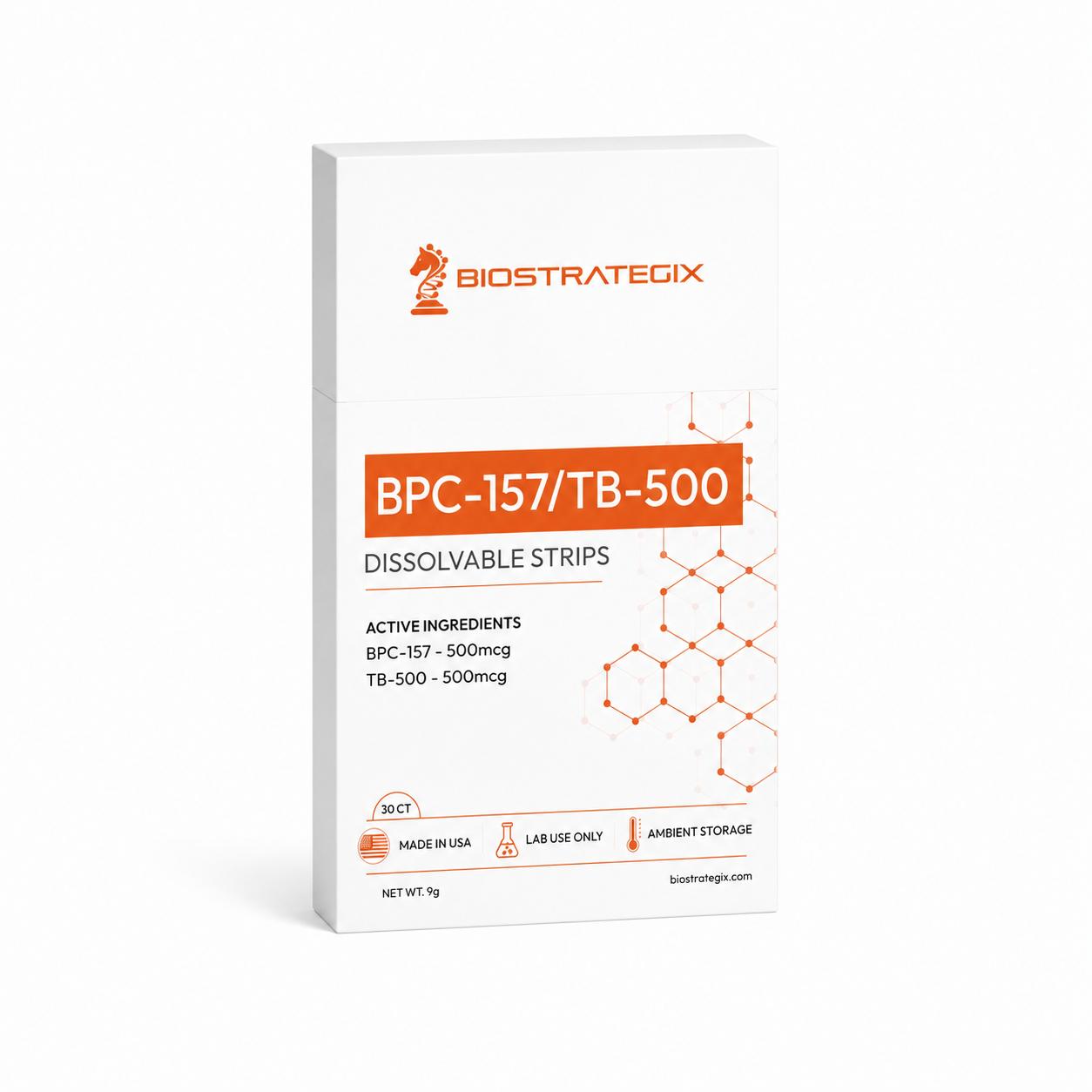
BPC-157/TB-500 Dissolvable Strips
$110.00
🔥 Exclusive Crypto Offer
Get an INSTANT 15% DISCOUNT when you pay with Bitcoin, Ethereum, Dogecoin, Bitcoin Cash, XRP, Solana, or USDT.
⚡ Don't have crypto? Buy it here in 5 minutes with easy guidance.
💡 Pro Tip: You can also pay with cryptocurrency using your verified Cash App or PayPal account for a fast and secure checkout!
At Biostrategix, we supply the BPC-157 TB-500 500mcg strip with matched content, 500mcg of each compound per film. Supplied for needle-free Wolverine Stack research, the pack holds BPC-157 TB-500 30 strips from a single lot.
BPC-157 is a pentadecapeptide of 1419.55 daltons and a partial sequence of a gastric juice protein. TB-500 is a shorter synthetic fragment corresponding to the active domain of thymosin beta-4.
What Is the Wolverine Stack?
“Wolverine stack” is community shorthand for pairing BPC-157 with TB-500 in tissue repair work. It is a colloquial label describing two compounds used together rather than a defined formulation or a fixed ratio.
The pairing has been tested directly once. In 32 rats undergoing Achilles tendon transection and repair, a four-arm study compared each compound alone, the combination, and controls, and reported outcomes for each arm across histology and load to failure.
The combination is therefore best understood as an active research question, and a wolverine stack strip peptide at a defined ratio gives a consistent starting point for work that explores it.
What TB-500 Is
Mass spectrometry identified the active component of material sold as TB-500 as an acetylated fragment of thymosin beta-4, corresponding to the seven-residue 17-23 sequence rather than the full-length protein. Usage of the term varies across commercial and research contexts, which is precisely why identity testing on the supplied lot is the determining document rather than the product name.
Local + Systemic Recovery: How BPC-157 and TB-500 Work Together
The two compounds are associated with different pathways in the published record, which is the basis for studying them together. What follows sets out each separately.
Thymosin Beta-4 and the LKKTETQ Domain
Thymosin beta-4 is a ubiquitous protein of 43 amino acids whose central actin-binding domain, LKKTETQ, sits at residues 17 to 23 and is associated with angiogenesis, wound healing and cell migration. That domain is what TB-500 corresponds to, which is the rationale for supplying the fragment rather than the whole protein.
In rats with full-thickness dermal wounds, the full-length protein increased re-epithelialization and keratinocyte migration. In mice, treatment after coronary artery ligation enhanced myocyte survival and cardiac function.
BPC-157 Across Repair Models
BPC-157’s record runs through different models. Rat studies report outcomes in gastric ulcer models by two routes, in myotendinous junction defects that do not resolve spontaneously, and in gastrocnemius crush injury.
Work in human endothelial cells and a rat hindlimb ischemia model reported activation of the VEGFR2-Akt-eNOS pathway, which is the angiogenic signalling route most often associated with this compound.
The Rationale for Pairing
The rationale researchers give is that these are separate pathways, one associated with actin dynamics and cell migration and the other with angiogenic signalling. That makes the combination a defined hypothesis rather than a settled mechanism, and a fixed-ratio film is the practical way to test it under consistent conditions.
Why Equal Dosing Matters — 500mcg / 500mcg
Each film is labelled at 500mcg of BPC-157 and 500mcg of TB-500, setting a 1:1 labelled ratio. Measured content for a given lot comes from that lot’s certificate of analysis.
Asymmetric films exist in this category, commonly pairing lower BPC-157 content with higher TB-500 content. With an uneven ratio, two variables move independently between that product and any 1:1 reference.
An equal dose BPC-157 TB-500 strip holds the intended proportion constant across every unit, so differences observed between conditions are attributable to the conditions rather than to a shifting balance between the two peptides.
Ratio and Molecular Size
The single published study of the combination used an asymmetric ratio, 10 micrograms per kilogram of BPC-157 against 60 micrograms per kilogram of TB-500 in rats. The two molecules also differ substantially in size: BPC-157 at 15 residues and 1419 Da against a seven-residue TB-500 fragment, so matched mass and matched behaviour are separate questions.
Sublingual Strip vs Injectable Format for Recovery Research
The difference between these formats is preparation and documentation. A film arrives with its content set at manufacture, while a lyophilized vial requires diluent, measurement and management of a reconstituted solution.
Orodispersible films are an established dosage form. They weigh under 200 mg in total, which reserves the formulation space for potent active ingredients, and a combined 1mg payload sits comfortably inside that envelope.
The practical advantages are procedural: content per unit is set before shipping, the material is handled dry, and there is no reconstituted solution to store or stability-track across a working period. Wolverine Stack no-injection handling removes several steps before any measurement begins.
Wolverine Stack Oral Strip Research Applications
A fixed-content film suits several in vitro workflows directly. Dissolution profiling under standardised conditions, content uniformity across a lot, and stability under controlled temperature and humidity are all measurable on the unit as supplied.
Comparative formulation work is the second application. With mass per unit set at manufacture, a film can be assessed against a reconstituted solution of known concentration without preparation variance entering the comparison.
Analytical method development is the third. A solid dosage form with a defined polymer matrix gives a consistent sample for extraction, recovery and assay validation work.
Can Peptides Absorb Sublingually?
Wolverine stack sublingual research turns on a defined set of transport parameters, and both compounds in this film sit within that design space at different points. BPC-157 TB-500 sublingual strip research therefore begins with molecular size, enzyme activity and residence time, set out below.
The Transport Parameters
The buccal barrier presents an effective pore radius of 1.5 to 3 nm. Compounds above 500 Da permeate at low rates, and most peptides exceed 1000 Da. Mucosal enzyme activity, residence time under salivary flow, and the swallowed fraction are the three further variables that govern any peptide held in the oral cavity.
Reported figures for peptides delivered buccally or sublingually sit in the range of 1% to 2%, and the FDA-approved sublingual desmopressin product documents 0.25% from an optimised commercial tablet.
Permeation Enhancers
Sodium caprate temporarily opens intercellular tight junctions and increases membrane fluidity, and in the work reporting that it performed comparably to the established benchmark in a gastrointestinal setting.
Cyclodextrins act primarily as solubilisers, carrying a compound to the membrane surface where the complex dissociates. Both are active areas of formulation research rather than settled solutions for the oral mucosa.
Where These Two Compounds Sit
A seven-residue fragment sits considerably closer to the permeability threshold than a 15-residue peptide at 1419 Da, which makes TB-500 the more physicochemically favourable of the two by this route. BPC-157 and TB-500 oral absorption research is still an open area for both compounds, and a fixed-content film is the format that makes such work tractable.
Certificate of Analysis & Purity Documentation
Biostrategix publishes third-party certificates of analysis in the Certificates of Analysis library, with testing by MDx Biolabs, MZ Biolabs, and Zyntro Analytical Lab Solutions, and separate endotoxin testing on many entries.
A BPC-157 TB-500 strip COA verified by a named laboratory carries extra weight for a two-compound film, because a single certificate accounts for both actives and confirms the ratio the product specifies.
Certificates are batch-specific and format-specific, so confirm one exists for the lot and dosage form received.
Storage & Handling
Store sealed strips in a cool, dry place away from direct light and keep the pouch closed until a strip is required. The property that makes a film disintegrate on contact with moisture also makes it responsive to ambient humidity.
Humidity control preserves both the physical integrity of the film and the stability of what it carries. Record lot number, receipt date, and storage conditions alongside experimental data, since long-term film stability is not yet characterised for either compound.
Related Formats in the Catalogue
Both compounds are supplied individually in vial format, as BPC-157 lyophilized powder and as TB-500 lyophilized powder, and the combination is available as BPC-157 with TB-500.
A single-compound strip is also offered as BPC-157 dissolvable strips, which gives a direct comparator for isolating the contribution of each active. Holding the molecule constant and varying only the format is the cleanest way to characterise what a film changes.
Buy BPC-157 TB-500 Oral Strip
Biostrategix stocks the BPC-157 TB-500 dissolvable strip in a 30-strip pack, shipped from California, with orders typically dispatched within 48 hours. Certificates of analysis for the catalogue are published openly, and lot documentation is available on request against the lot number printed on the pouch.
Order the BPC-157 TB-500 500mcg dissolvable strip from Biostrategix.
Frequently Asked Questions
What human research exists for thymosin beta-4?
Clinical development has used the full-length protein rather than the fragment. A phase 3 trial in a corneal indication reported healing in 6 of 10 treated patients against 1 of 8 on placebo at day 29, and the programme concluded early at 18 participants. Reviews separating the two note that direct research on the fragment is at an earlier stage than research on the full-length protein.
What is the regulatory position of these compounds?
Neither is an approved drug, and both are supplied as research materials. Thymosin beta-4 and its derivatives, and BPC-157, are both listed by anti-doping authorities as prohibited in competitive sport at all times.
Can peptide content be verified independently?
Yes. Third-party identity and purity testing is published in the Biostrategix certificates of analysis library. Given the naming variation around TB-500, identity testing is the reliable check on lot contents.
What in vitro work does this format support?
Dissolution profiling, content uniformity across a lot and stability testing under controlled conditions are all measurable on the unit as supplied. For a two-compound film there is a further application: assessing the ratio of the two actives across units, which is the measurement a blended product most needs.
How should a lot be verified on receipt?
Match the lot number printed on the pouch against the certificate for that lot, and confirm the certificate covers the strip format and both actives. Identity, purity and content are three separate determinations, and for a blend the ratio between the two compounds is a fourth.
What does the 30-strip format offer?
A 30-strip pack provides a single lot across an extended working period, which removes lot-to-lot variation from a sequence of related experiments. Each unit is individually sealed, so opening one strip leaves the remainder of the pack unaffected.
Legal Disclaimer
These products are intended as research materials only.
This designation allows the use of research chemicals strictly for in vitro testing and laboratory experimentation only. All product information available on this website is for educational purposes only. Bodily introduction of any kind into humans or animals is strictly forbidden by law and is not endorsed by this website. This product should only be handled by licensed, qualified professionals. This product is not a drug, food, or cosmetic and may not be misbranded, misused, or mislabeled as a drug, food, or cosmetic.
| Amount | BPC/TB 500mcg/500mcg each (30 Strips) |
|---|
Only logged in customers who have purchased this product may leave a review.
Related products
Home page
Home page
Home page
Home page
Home page
Home page
Home page
Home page
Reviews
There are no reviews yet.