
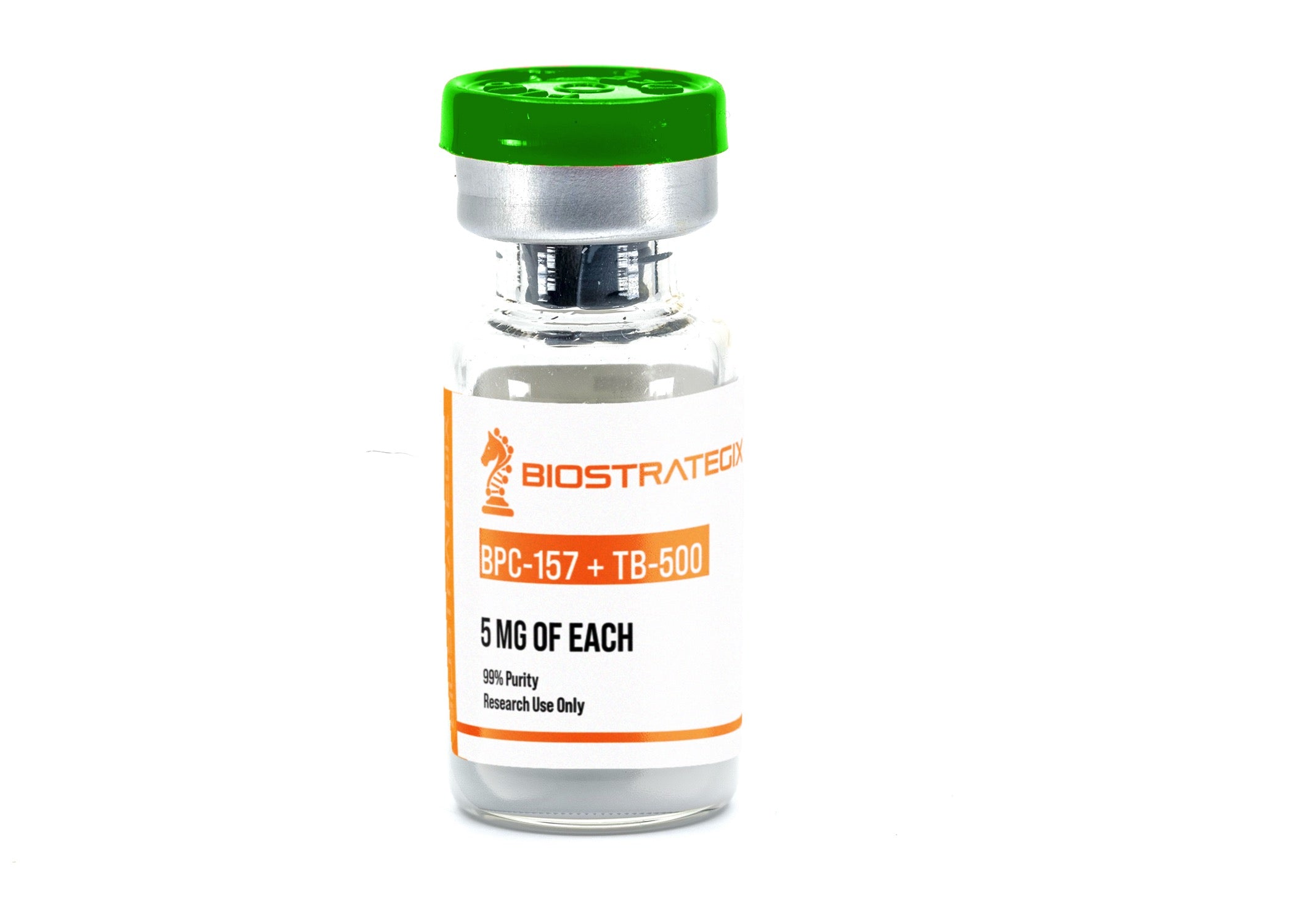
BPC-157 + TB500
Price range: $90.00 through $440.00
🔥 Exclusive Crypto Offer
Get an INSTANT 15% DISCOUNT when you pay with Bitcoin, Ethereum, Dogecoin, Bitcoin Cash, XRP, Solana, or USDT.
⚡ Don't have crypto? Buy it here in 5 minutes with easy guidance.
💡 Pro Tip: You can also pay with cryptocurrency using your verified Cash App or PayPal account for a fast and secure checkout!
The BPC-157 TB-500 blend combines two unrelated research peptides in one lyophilized vial: BPC-157, a 15-residue gastric protein fragment, and TB-500, a thymosin beta-4 material. At Biostrategix, we supply the BPC-157 TB-500 10mg vial at 5mg of each compound, documented by third-party certificates for every lot we have tested.
The pairing is known in supplier catalogs and search as the Wolverine Stack peptide blend. We supply the blend, the individual compounds and a strip format so each arm of such a study can draw on documented material.
What Is the BPC-157 + TB-500 Blend?
The BPC-157 + TB-500 blend is a single lyophilized vial holding two peptides at a fixed ratio. BPC-157 is a pentadecapeptide of about 1419.5 g/mol, and the TB-500 component in our certified lots is identified by mass as full-length thymosin beta-4.
BPC-157 is a partial sequence of a human gastric juice protein. A 2025 review of BPC 157 pharmacology describes it as stable in human gastric juice for more than 24 hours.
Thymosin beta-4 is a 43-residue mature protein with an N-terminal acetyl group. The UniProt entry for human thymosin beta-4 records its function as binding and sequestering G-actin to inhibit polymerization.
Which TB-500 Is in the Vial
TB-500 is a name used for two different materials. FDA’s 2026 review of TB-500 bulk substances describes TB-500 as Ac-LKKTETQ, the acetylated residues 17 to 23 of thymosin beta-4, at 889.01 g/mol, and states that TB-500 and thymosin beta-4 are not the same substance.
The certificates for our blend lots identify the second component as thymosin beta-4, with a measured monoisotopic mass of 4960.49 daltons against an expected 4960.48. TB-500 thymosin beta-4 research depends on knowing which of the two a vial holds, and our certificates answer that by mass.
Why Researchers Combine BPC-157 and TB-500
Researchers study BPC-157 and TB-500 together because the two act on different systems. BPC-157 is associated with VEGFR2 and nitric oxide signaling, and thymosin beta-4 with actin sequestration, so a combined arm tests whether separate pathways add up.
That question has been tested in one published study that we found. A 2026 rat Achilles repair study in 32 Sprague-Dawley rats ran four arms over 30 days: control, BPC-157 alone, TB-500 alone and both together.
The combined arm produced no additive gain. The authors concluded that the combination did not outperform either agent alone and suggested the two may converge on shared downstream pathways.
What the Combination Study Measured
Median load to failure was 26.91 N in controls, 37.16 N with BPC-157, 37.41 N with TB-500 and 34.54 N with both. Only the TB-500 arm differed significantly from control, at p = 0.0406.
On histology, the combined arm showed lower Movin scores than controls (p = 0.040), while total Bonar scores for the combined arm did not differ significantly. The authors described the findings as hypothesis-generating rather than confirmatory.
Other Blends Containing Both Compounds
BPC-157 and thymosin beta-4 also appear in our three- and four-compound blends. The KLOW blend with GHK-Cu and KPV adds two further peptides at 50mg, 10mg, 10mg and 10mg, and its lots carry their own certificates.
Those blends answer a different design question from the two-compound vial. The full range sits in our full peptides and more research catalog.
Wolverine Stack: Origins of the Name and Research Context
Wolverine Stack is a market name for the BPC-157 and TB-500 pairing, used in supplier catalogs and search rather than in the scientific literature. Published studies refer to the two compounds by their chemical names, and the name carries no defined ratio or formulation.
The name tracks search interest in the pair. Wolverine Stack research in the strict sense means the combination studies, and a 2026 scoping review of 80 studies of thymosin beta-4 and TB-500 reports no study that combined them with BPC-157.
BPC-157 + TB-500 vs Individual Vials: Ratio and Format Flexibility
A blend vial fixes the ratio at manufacture, while separate vials let the ratio be set at the bench. Our blend holds equal mass of each compound, and individual vials suit designs that vary one compound independently of the other.
Equal mass is not equal molar quantity. With monoisotopic masses of 1418.70 daltons for BPC-157 and 4960.48 daltons for thymosin beta-4, an equal-mass vial holds about 3.5 times more BPC-157 molecules than thymosin beta-4 molecules.
When Separate Vials Fit the Design
Designs that need a ratio series, a single-compound control or a molar match call for the components separately. We supply the BPC-157 research vial in 5mg and 10mg sizes and our TB500 research vials in 5mg and 10mg for that purpose.
The blend suits designs where a fixed ratio is the variable under study. It also removes a weighing and mixing step from each preparation, and every BPC-157 TB-500 vial in a lot shares the same certificate.
The Strip Format
We also supply the pair as a film. Our BPC-157/TB-500 dissolvable strips at 500mcg each carry 500mcg of each compound per strip, 30 strips per pack, with content fixed per unit at manufacture.
Mechanism: How the Two Peptides Complement Each Other in Animal Models
The BPC-157 TB-500 mechanism pairing is often summarized as BPC-157 angiogenesis, TB-500 actin. BPC-157 work centers on VEGFR2, eNOS and nitric oxide signaling, while thymosin beta-4 work centers on G-actin sequestration and cell migration.
BPC-157 and VEGFR2 Signaling
A 2017 study in endothelial cells and rats reported increased vessel density in chick chorioallantoic membrane and tube-formation assays and faster blood-flow recovery in rat hindlimb ischemia. It also reported raised VEGFR2 expression and internalization with VEGF-A unchanged, and activation of VEGFR2, Akt and eNOS.
The nitric oxide link was examined in isolated vessels. A 2020 study in isolated rat aorta reported endothelium-dependent, NO-dependent relaxation, and in endothelial cells increased phosphorylation of Src, caveolin-1 and eNOS, which the authors linked to a likely Src-Caveolin-1-eNOS pathway.
In a rat muscle injury model, BPC-157 showed no direct angiogenic effect in an in vitro tube assay but shifted VEGF peaks earlier in vivo. The vascular effect therefore appears to depend on tissue context rather than on direct stimulation of endothelial cells.
Thymosin Beta-4 and Actin
Thymosin beta-4 binds G-actin in a 1 to 1 complex and appears to be the main G-actin-sequestering protein in resting human neutrophils. A 1992 study mapping the actin-binding site identified the LKKTET hexapeptide as the main electrostatic contact with actin.
In cells, thymosin beta-4 formed a complex with PINCH and ILK and activated Akt, and a 2004 mouse coronary ligation study reported improved cardiomyocyte survival and cardiac function after ligation. The fragment itself has a thinner record: in fibroblast scratch assays, Ac-LKKTETQ at 50 µg/mL did not close wounds while its metabolite Ac-LKKTE showed significant wound-closing activity against control.
Human Data on Thymosin Beta-4
Human data on thymosin beta-4 come mainly from eye and skin studies, and the clearest controlled data come from the cornea. A 2023 phase 3 corneal trial reported on 18 participants against 46 planned, and its primary endpoint at day 29 was not met (p = 0.0656). At day 43, a secondary measure, complete resolution of the epithelial defect was 50 percent in the active arm against 0 percent on placebo (p = 0.0359).
Certificate of Analysis: BPC-157 + TB-500 Blend
The BPC-157 TB-500 COA record covers three blend lots. The most recent, MDx Biolabs lot CG-26 reported 4 October 2025, shows 99.6 percent overall purity, measured content of 5.09 mg and 5.11 mg, and endotoxin at or below 0.05 EU/mL.
The MDx Biolabs certificate for lot CG-26 is posted with the earlier MZ Biolabs lots in our third-party certificates of analysis library. MZ lot CG-24, analyzed 1 May 2025, reported 99.41 percent combined purity with 5.76 mg of BPC-157 and 6.32 mg of thymosin beta-4 per vial.
What the Blend Certificates Show
Each blend certificate reports both peptides separately. Mass spectrometry confirmed BPC-157 at 1418.72 daltons and thymosin beta-4 at 4960.49 daltons on lot CG-24, and HPLC separated the two as distinct peaks.
All three certified lots carry the 5mg-of-each fill. Certificates apply only to the lot they name.
Purity and Content Across Laboratories
Purity figures are consistent across the three lots, between 99.37 and 99.6 percent. Content figures vary more, from 5.09 mg on the MDx certificate to 6.32 mg for thymosin beta-4 on the MZ certificate, against a 5mg label.
Purity and content are separate measurements. Purity is the share of detected material that is the target peptide, while content is the mass actually present, and laboratories quantify content by different methods.
Storage, Reconstitution, and Handling
The blend ships as a lyophilized solid and is stored desiccated and frozen. BPC-157 TB-500 reconstitution for in vitro work follows the assay design, with the lot certificate setting the reference mass for each component.
Peptide blend vial research adds one consideration over single-compound work. Both peptides go into solution together, so any change in buffer or concentration applies to both at once.
Stability and Adsorption
Lyophilized storage is recorded below minus 18 degrees Celsius for BPC-157 and at minus 20 or minus 80 degrees Celsius for the TB-500 fragment, and FDA’s TB-500 review notes that peptides are sensitive to pH, temperature and concentration. We found no published study of the two peptides co-lyophilized in one vial, which leaves blend stability as an open question.
Some peptides, particularly cationic ones, are lost to glass and polypropylene surfaces at low concentration. Dilute solutions are best prepared close to measurement and logged against the lot number.
Buy BPC-157 TB-500 Blend Research Vials
At Biostrategix, we supply the BPC-157 + TB500 blend as a 10mg vial holding 5mg of each compound, at $90.00 for a single vial and $440.00 for a five-pack. Both options are in stock as of October 2026.
Orders ship within 48 hours by USPS Priority or Express from California. Researchers who buy BPC-157 TB-500 from us receive a lyophilized research material with posted blend certificates.
Order the BPC-157 and TB-500 blend vial today.
Frequently Asked Questions
What is in the BPC-157 + TB-500 blend?
The vial holds 5mg of BPC-157 and 5mg of a thymosin beta-4 material in lyophilized form, 10mg in total. Our certificates identify the second component by mass as full-length thymosin beta-4.
What is the Wolverine Stack?
It is a market name for the BPC-157 and TB-500 pairing. It is not a scientific term, and it does not define a ratio or a formulation.
Has BPC-157 and TB-500 together been studied?
Yes, in one published study that we found. A 2026 rat Achilles repair study compared the two alone and combined over 30 days and found the combination produced no additive gain over either compound alone.
Is TB-500 the same as thymosin beta-4?
Not by FDA’s description. FDA describes TB-500 as the 7-residue acetylated fragment Ac-LKKTETQ, while thymosin beta-4 is the 43-residue protein, and our blend certificates identify the latter by mass.
What does BPC-157 vs TB-500 come down to?
They are unrelated molecules with different mechanisms. BPC-157 work centers on VEGFR2 and nitric oxide signaling, and thymosin beta-4 work on actin sequestration.
Is there a COA for the blend?
Yes. The most recent lot, CG-26, reported 99.6 percent purity, 5.09 mg and 5.11 mg measured content, and a passing endotoxin result, and two earlier lots are also posted.
What is the regulatory status of the two compounds?
Neither is approved by FDA, and FDA’s 2026 reviews weighed against adding either to the compounding bulk substances list. The World Anti-Doping Agency prohibits BPC-157 under S0 and thymosin beta-4 and its derivatives under S2.
All products are sold for research, laboratory, and analytical purposes only. Not for human or animal consumption. These statements have not been evaluated by the FDA.
| Amount | 10MG of Each |
|---|---|
| How Many? | Five Pack, Single |
Only logged in customers who have purchased this product may leave a review.
Related products
Home page
Fall Flash Sale
Home page
Home page
Home page
Home page
Home page
Fall Flash Sale
Reviews
There are no reviews yet.