
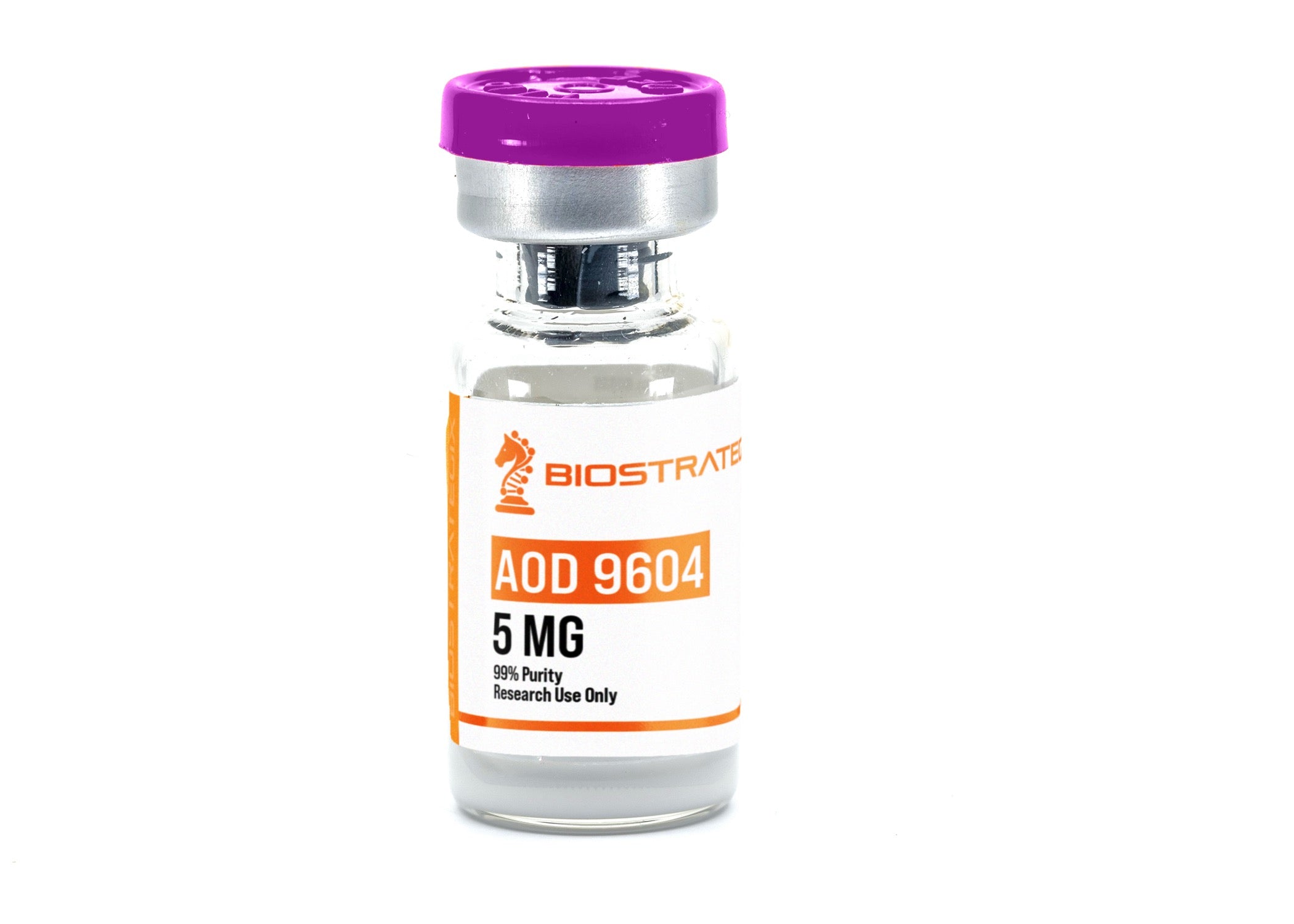
AOD 9604
Price range: $45.00 through $225.00
🔥 Exclusive Crypto Offer
Get an INSTANT 15% DISCOUNT when you pay with Bitcoin, Ethereum, Dogecoin, Bitcoin Cash, XRP, Solana, or USDT.
⚡ Don't have crypto? Buy it here in 5 minutes with easy guidance.
💡 Pro Tip: You can also pay with cryptocurrency using your verified Cash App or PayPal account for a fast and secure checkout!
AOD 9604 is a 16-residue synthetic peptide built on the C-terminal region of human growth hormone, widely sold under the name HGH Fragment 176-191. At Biostrategix, we supply AOD 9604 5mg as a lyophilized research vial, documented by a third-party certificate of analysis.
The compound also reached human trials. Six sponsor-funded randomized trials enrolled close to 900 adults before the obesity program closed in 2007, and that record now sits alongside a much larger body of rodent work on lipolysis and fat oxidation.
AOD 9604 is an investigational compound with no approved indication anywhere. We supply it strictly as a research material for in vitro and laboratory work.
What Is AOD 9604? Understanding the GH Fragment
AOD 9604 is hGH residues 177 to 191 with an added N-terminal tyrosine. The 16-residue sequence is YLRIVQCRSVEGSCGF, with a disulfide bond between Cys7 and Cys14. The free base has a molecular weight of 1,815.09 g/mol, and the acetate salt 1,875.1 g/mol.
That sequence places AOD 9604 among the GH fragment peptide research compounds, a small group derived from regions of growth hormone rather than from the whole 191-residue protein. A 2024 FDA briefing document on AOD-9604 records the sequence, the disulfide bridge and both salt forms, and describes the compound as not physically and chemically well characterized.
The added tyrosine was introduced to stabilize the fragment, as set out in the 2013 pooled safety review of AOD9604. Its formula, C78H123N23O23S2, is indexed under PubChem compound record 71300630 for AOD-9604.
HGH Fragment 176-191 Research Nomenclature
HGH fragment 176-191 research and AOD 9604 research overlap, but the two names are not strictly identical. In the UniProt sequence of human growth hormone, residues 176 to 191 read FLRIVQCRSVEGSCGF and begin with phenylalanine, while AOD 9604 begins with tyrosine.
That single substitution is why AOD 9604 is described as Tyr-hGH 177-191, and why the anti-doping list names AOD-9604 and hGH 176-191 as separate examples. At Biostrategix, we supply AOD 9604, the tyrosine form, and give the fragment name alongside it because both terms are used to search for this material.
AOD 9604 vs HGH: Why the Fragment Differs From Full Growth Hormone
AOD 9604 vs HGH comes down to receptor engagement. Full growth hormone binds the GH receptor and drives IGF-1 and glucose effects, while the fragment did not compete for GH receptor binding in cell assays and did not raise IGF-1 in human trials.
The receptor finding comes from cell work. A 2001 study in receptor-expressing BaF-BO3 cells reported that AOD9604 did not compete for radiolabeled hGH binding and did not induce proliferation of the receptor-bearing cells. In obese mice treated for 14 days in the same study, AOD9604 raised fat oxidation and plasma glycerol without the hyperglycemia or reduced insulin secretion seen with hGH.
The IGF-1 finding comes from the human trials. In the 24-week trial, serum IGF-1 did not differ from placebo at 12 weeks (P = 0.508) or at 24 weeks (P = 0.758).
What the Comparison Leaves Open
The FDA briefing document states that no nonclinical data were identified to confirm the absence of an IGF-1 effect. It also records that the molecular target of AOD 9604 has not been identified.
That makes the fragment’s receptor pharmacology an open research question rather than a settled distinction. A defined GH-receptor-negative profile in cells, paired with an unidentified primary target, is the gap most in vitro work on this compound is positioned to address.
At Biostrategix, we stock AOD 9604 alongside other growth hormone axis research compounds, such as our CJC-1295 (NO DAC) growth hormone research compound. Each is documented by its own lot certificates.
Metabolic Research Applications: Adipogenesis and Lipolysis Studies
AOD 9604 metabolic research centers on adipose tissue. Rodent studies reported reduced lipogenesis, increased lipolysis and increased fat oxidation, without the hyperglycemia or loss of insulin sensitivity seen with hGH, which defines the compound’s main preclinical profile.
Early work used obese Zucker rats. A 2000 study in obese Zucker rats reported weight gain of 15.8 g against 35.6 g in controls over 19 days by the oral route, together with increased lipolytic activity in adipose tissue and no adverse change in insulin sensitivity on euglycemic clamp.
AOD 9604 adipogenesis questions remain open, since the published rodent work measured lipogenesis, lipolysis and fat oxidation rather than adipocyte differentiation. The FDA briefing document summarizes the rodent record as reduced lipogenesis and increased lipolysis and fatty acid oxidation in obese animals.
AOD 9604 Beta-3 Adrenergic Findings
The AOD 9604 beta-3 adrenergic question was tested directly in knockout mice. A 2001 study in obese and knockout mice found that hGH and AOD9604 both restored suppressed beta-3 adrenergic receptor RNA in obese mice to lean-mouse levels.
In knockout animals, chronic exposure produced no reduction in body weight and no increase in lipolysis. Acute AOD9604 still raised energy expenditure and fat oxidation in the same knockout mice.
The authors concluded the effects were not mediated directly through the beta-3 receptor, though higher receptor expression may raise lipolytic sensitivity. AOD 9604 mechanism lipolysis research therefore frames beta-3 expression as a possible contributor to lipolytic sensitivity rather than as the direct mediator.
Other Preclinical Models
AOD 9604 has also been studied outside adipose tissue. A 2015 rabbit knee osteoarthritis study in 32 New Zealand White rabbits reported the best gross and histologic cartilage scores in the group receiving AOD9604 with hyaluronic acid.
AOD 9604 in the Wider Metabolic Peptide Landscape
GLP-1 receptor agonists now dominate metabolic peptide research, and AOD 9604 sits on a different axis. Incretin receptor agonists act at a defined receptor and have been tested in large randomized human trials, while AOD 9604 is a growth hormone fragment with no identified receptor target.
At Biostrategix, we stock incretin-class materials such as the GLP-Sema research compound in vial format alongside GH-axis compounds. The two classes address different mechanistic questions and are cataloged separately in our full peptides and more research catalog.
AOD 9604 Phase II Clinical Trials: What the Data Shows
AOD 9604 clinical trials ran through Metabolic Pharmaceuticals in the early 2000s. Six randomized, double-blind, placebo-controlled trials enrolled 893 participants, and the program closed in 2007 after the largest trial missed its primary endpoint.
The trials covered intravenous and oral formulations. The two largest were a 12-week oral trial in 300 participants and a 24-week oral trial with 502 participants randomized.
Efficacy Findings
The FDA record is the most complete public account of the efficacy data. The FDA briefing document reports a body-weight reduction of 0.22 kg per week in the 1 mg arm of the 12-week trial against 0.07 kg per week on placebo, a difference FDA described as of unclear therapeutic meaning.
In the 24-week trial, FDA’s briefing document records no significant difference in body weight at 12 weeks, the primary endpoint. FDA’s overall assessment found a lack of evidence of effectiveness in obesity by any route.
Tolerability Findings
The pooled review of all six trials described the adverse-event profile as indistinguishable from placebo, though the body of the paper reports one serious adverse event in a dose-escalation study judged possibly related. No anti-AOD9604 antibodies were detected in any participant assayed.
All six trials were funded by the sponsor, and two of the review’s three authors had ties to the company. FDA has separately flagged immunogenicity and peptide-impurity questions for the compound.
Regulatory Position
FDA’s December 2024 compounding advisory committee minutes record a 0 to 12 vote against placing AOD-9604 on the 503A bulk substances list. It now sits on FDA’s list of compounding safety-risk substances as previously in category 2 and withdrawn by the nominators. That page also notes serious adverse events that may be associated with AOD-9604, with causality unclear.
AOD 9604 Reconstitution and Solution Handling
AOD 9604 reconstitution for in vitro work starts from the salt form. The free base and acetate differ by about 60 g/mol, so the certificate’s identity data set the molar basis for any stock solution prepared for an assay.
A 5mg lyophilized vial holds the peptide as a dry solid. The diluent for in vitro work is set by the assay buffer and the experimental design, not by a fixed recipe, and the vial label and lot certificate are the reference points for mass.
Structural Points Relevant to Solution Work
The Cys7 to Cys14 disulfide bridge is part of the molecule’s defined structure. Buffer systems for in vitro assays are chosen with that bond in mind, since its integrity is part of the identity that the mass spectrometry on the certificate confirms.
Certificate of Analysis and Purity Documentation
AOD 9604 COA purity is documented by MZ Biolabs for lot HP-603, analyzed on 20 March 2024. The certificate reports 97.16 percent purity by HPLC-UV, with identity confirmed by mass spectrometry at 1813.89 against an expected 1813.86.
The MZ Biolabs certificate for lot HP-603 is posted in our third-party certificates of analysis library, alongside the other lots we have had tested. Two chromatographic peaks were detected, with AOD 9604 at 97.16 percent of area and a single minor peak at 2.84 percent.
Purity and content are separate measurements. This certificate reports purity and identity, and a certificate applies to the lot it names only.
Storage and Handling
AOD 9604 ships as a lyophilized solid. Lyophilized research peptides are held desiccated and frozen, below minus 18 degrees Celsius, and a prepared solution is treated as a separate, shorter-lived material with its own preparation date.
The dry vial is the stable form, so the material stays sealed, desiccated and lyophilized until an assay calls for it. Moisture is the main concern for a freeze-dried peptide, which is why desiccated storage is the standard condition.
Handling Low-Concentration Solutions
Some peptides, particularly cationic ones, are lost to glass and polypropylene surfaces at low concentration. Dilute solutions are therefore best prepared close to the point of measurement, in low-binding tubes where the assay allows.
Each preparation is logged against the lot number on the vial and its certificate. That record ties every in vitro reading back to a documented batch.
Buy AOD 9604 Peptide
At Biostrategix, we list AOD 9604 5mg as a single lyophilized vial at $45.00 and as a five-pack of vials at $225.00. Both options are out of stock as of October 2026, and the lot certificate from the most recent tested batch stays posted in our library.
Orders ship within 48 hours by USPS Priority or Express from California. Researchers comparing AOD 9604 for sale across suppliers can check the posted lot certificate before ordering, and every AOD 9604 research peptide order is supplied for laboratory use only.
Check the AOD 9604 listing for the next lot, and review the certificate before ordering.
Frequently Asked Questions
What is AOD 9604?
AOD 9604 is a 16-residue synthetic peptide made of human growth hormone residues 177 to 191 with an added N-terminal tyrosine. It is widely sold as HGH Fragment 176-191, and it is an investigational compound with no approved indication.
Is AOD 9604 the same as HGH Fragment 176-191?
Not exactly. Native growth hormone residues 176 to 191 begin with phenylalanine, while AOD 9604 begins with tyrosine, though the fragment name is widely used for AOD 9604. The anti-doping list names the two separately.
How does AOD 9604 differ from growth hormone?
In receptor-expressing cell assays, AOD 9604 did not compete for growth hormone receptor binding. In human trials, it did not change serum IGF-1 relative to placebo, and in mice it did not cause the hyperglycemia seen with growth hormone.
Did AOD 9604 reach human clinical trials?
Yes. Six randomized, placebo-controlled trials enrolled 893 adults, and the obesity program ended in 2007 after the largest trial missed its primary endpoint. FDA later found a lack of evidence of effectiveness in obesity.
Does AOD 9604 act through beta-3 adrenergic receptors?
Not directly. In mouse studies it raised beta-3 receptor expression, but chronic effects were absent in knockout mice while acute fat oxidation persisted, so the authors concluded the effects were not mediated directly through the receptor, though higher expression may contribute to lipolytic sensitivity.
What is the regulatory status of AOD 9604?
AOD 9604 is not approved by FDA. An FDA advisory committee voted 0 to 12 against adding it to the compounding bulk substances list in 2024, and the World Anti-Doping Agency names AOD-9604 among the growth hormone fragments prohibited at all times.
Is there a certificate of analysis for AOD 9604?
Yes. MZ Biolabs tested lot HP-603 in March 2024 and reported 97.16 percent purity by HPLC with identity confirmed by mass spectrometry. The certificate applies to that lot only.
All products are sold for research, laboratory, and analytical purposes only. Not for human or animal consumption. These statements have not been evaluated by the FDA.
| Amount | 5 MG |
|---|---|
| How Many? | Five Pack, Single Vial |
Only logged in customers who have purchased this product may leave a review.
Related products
Home page
Home page
Home page
Home page
Home page
Home page
Home page
Home page
Reviews
There are no reviews yet.