
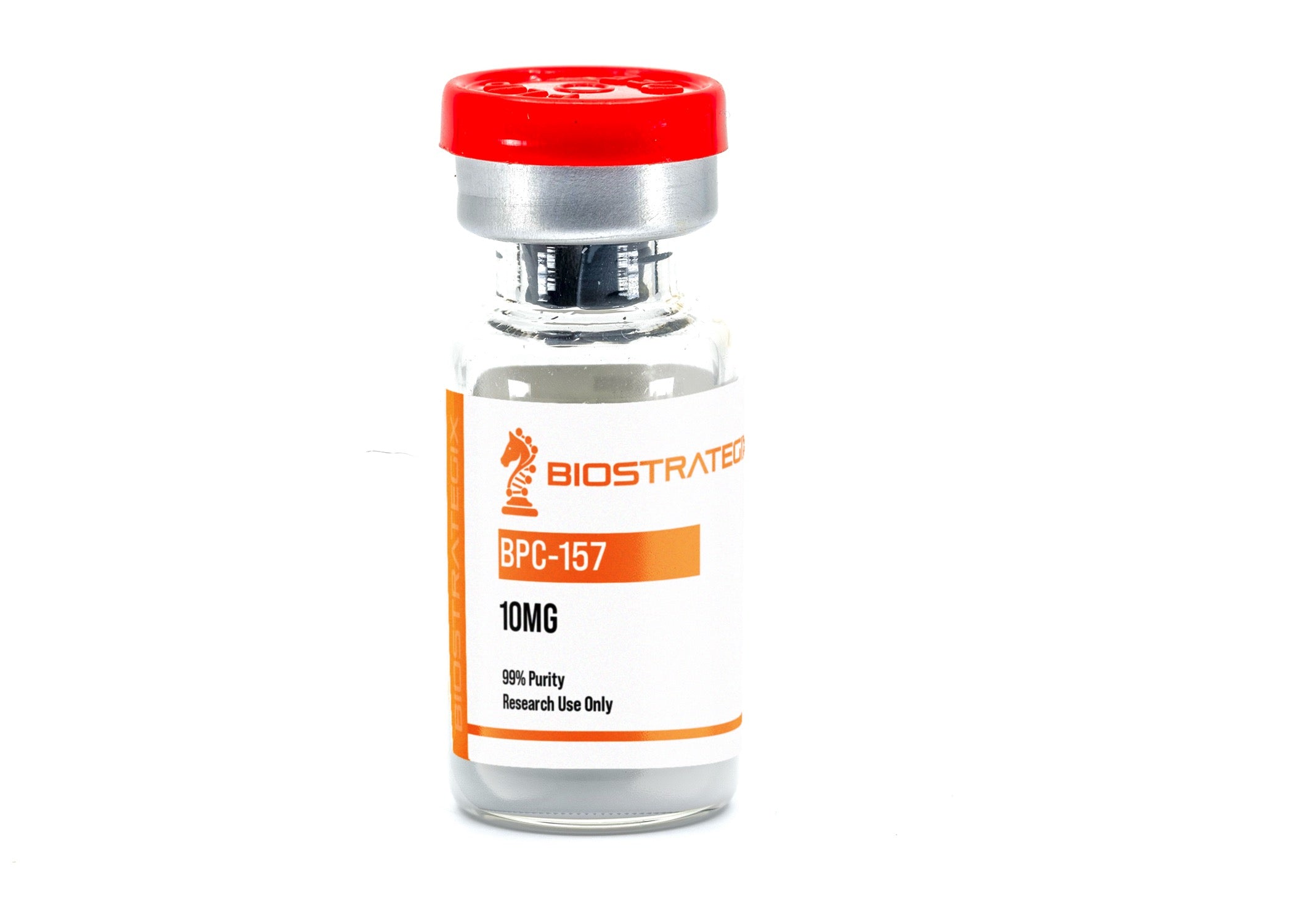
BPC-157
Price range: $30.00 through $240.00
🔥 Exclusive Crypto Offer
Get an INSTANT 15% DISCOUNT when you pay with Bitcoin, Ethereum, Dogecoin, Bitcoin Cash, XRP, Solana, or USDT.
⚡ Don't have crypto? Buy it here in 5 minutes with easy guidance.
💡 Pro Tip: You can also pay with cryptocurrency using your verified Cash App or PayPal account for a fast and secure checkout!
BPC-157 is a synthetic 15-residue peptide taken from a partial sequence of a human gastric juice protein. At Biostrategix, we supply BPC-157 5mg and 10mg as lyophilized research vials, with third-party certificates reporting purity above 99 percent on the tested lots.
BPC-157 has a large preclinical record, built mostly in rat models of gastric, tendon and vascular injury. Human data remain limited to a few small exploratory studies, which leaves most of the compound’s biology open to laboratory work.
We also carry BPC-157 in oral tablet and dissolvable strip formats, so the same sequence is available in three material forms. Each BPC-157 research peptide vial we supply is sold for in vitro and laboratory use only.
What Is BPC-157?
BPC-157 is the pentadecapeptide Gly-Glu-Pro-Pro-Pro-Gly-Lys-Pro-Ala-Asp-Asp-Ala-Gly-Leu-Val, molecular weight 1419.55 daltons. It is a partial sequence of the gastric juice protein BPC, the source of the name body protection compound, and it is investigational with no approved indication.
The gastric origin also explains its best-known property. A 2025 review of BPC 157 pharmacology describes the peptide as native to and stable in human gastric juice for more than 24 hours.
BPC-157 is also cataloged under the code PL14736 and the name Bepecin. Its formula is C62H98N16O22, and it is supplied as a white to off-white lyophilized solid.
Where BPC-157 Research Stands
Research peptides BPC-157 work is overwhelmingly preclinical. A 2025 systematic review of BPC-157 studies included 36 studies, of which 35 were preclinical and one was clinical, and no meta-analysis was possible.
The single registered human trial, a phase 1 oral study in healthy volunteers started in 2015, lists its status as unknown with no posted findings. That gap between a deep animal record and a thin human one is the defining feature of the compound.
BPC-157 Research: Tissue Repair and Angiogenesis Signaling
BPC-157 has been studied mainly in rat models of gastric lesions, tendon transection and limb ischemia. The mechanistic work points to VEGFR2 signaling, nitric oxide pathways and fibroblast migration, mapped in cell culture and isolated tissue alongside the animal models.
These findings come from defined models, and each is reported in its own species and system. Together they describe the BPC-157 mechanism of action as a set of signaling effects rather than a single receptor target.
Gastric Lesion Models
The gastric work is the oldest part of the record. A 2004 study in 330 Wistar rats across indomethacin, pylorus-ligation and acetic acid ulcer models reported ulcer inhibition of 45.7 to 65.6 percent at the two higher amounts tested.
Tendon and Fibroblast Models
Tendon is the second major research area. A 2003 rat Achilles tendon transection study reported higher load to failure, higher Young’s modulus and a higher Achilles functional index over 14 days, with smaller defects.
In isolated tendon fibroblasts, BPC-157 accelerated explant outgrowth and increased cell migration, spreading and F-actin formation without directly raising proliferation. The same cells showed increased phosphorylation of FAK and paxillin, and a later study in rat Achilles fibroblasts reported growth hormone receptor expression rising up to about sevenfold by day three.
Angiogenesis and Nitric Oxide Signaling
BPC-157 angiogenesis research centers on VEGFR2 rather than VEGF itself. A 2017 study in endothelial cells and rats reported increased vessel density in chick chorioallantoic membrane and tube-formation assays, faster blood-flow recovery in rat hindlimb ischemia, and raised VEGFR2 expression and internalization with VEGF-A unchanged.
The nitric oxide work extends that pathway. A 2020 study in isolated rat aorta reported endothelium-dependent, NO-dependent relaxation, and in endothelial cells increased phosphorylation of Src, caveolin-1 and eNOS, which the authors linked to a likely Src-Caveolin-1-eNOS pathway.
One nuance stays in the record. In a rat muscle injury study, BPC-157 showed no direct angiogenic effect in an in vitro tube assay but shifted VEGF, CD34 and factor VIII peaks earlier in vivo, so the effect appears to depend on the tissue context.
Vial vs Oral vs Sublingual Strip: BPC-157 Format Overview
At Biostrategix, we supply BPC-157 in three material formats: a lyophilized vial, an oral tablet and a sublingual dissolvable strip. They share one sequence and differ in how content is fixed, how the material is prepared and what pharmacokinetic data exist for each form.
The BPC-157 vial holds a set mass of dry peptide, and the concentration of any working solution is set at the bench. Our BPC-157 oral tablets at 500mcg each and our BPC-157 dissolvable strips in 500mcg format fix content per unit at manufacture.
What the Pharmacokinetic Record Covers
The pharmacokinetic data identified in FDA’s 2026 review cover only intravenous and intramuscular routes. A 2022 study in rats and beagle dogs reported intravenous half-lives of 15.2 minutes in rats and 5.27 minutes in dogs, with intramuscular bioavailability of 14 to 19 percent in rats and 45 to 51 percent in dogs.
The same study found the peptide rapidly broken down, with tritiated proline making up 86.65 percent of plasma radioactivity at one hour and the highest tissue levels in the kidney. Oral bioavailability was not measured, and FDA’s 2026 review identified no study that established it.
Oral and Sublingual Research Questions
Rodent studies have used drinking water and intragastric routes alongside parenteral ones. A BPC-157 sublingual strip raises a separate question, since we found no study measuring transmucosal absorption of this peptide.
Both are open research areas. A fixed-content film or tablet is the format that makes those questions measurable, because the mass per unit is set before any experiment begins.
BPC-157 Reconstitution and Solution Handling
BPC-157 lyophilized powder is water-soluble, with solubility in water of 5 mg/mL recorded in FDA’s 2026 review. For in vitro work, the diluent and concentration are set by the assay, and the vial mass and lot certificate are the reference points.
The question of how to reconstitute BPC-157 for an assay is answered by the experimental design rather than a fixed recipe. Buffer, target concentration and the number of aliquots all follow from the measurement being made.
Solution Stability and Record Keeping
Once in solution, BPC-157 is a different material from the dry vial. Vendor stability data summarized in the FDA 2026 BPC-157 briefing document give 2 to 3 weeks at 4 degrees Celsius and 3 to 4 months at minus 20 degrees Celsius for a prepared solution.
Each prepared solution is logged with its lot number, preparation date and concentration. Some peptides, particularly cationic ones, are lost to glass and polypropylene surfaces at low concentration, so dilute solutions are best prepared close to the point of measurement.
BPC-157 vs TB-500: Which Research Compound Fits the Study
BPC-157 vs TB-500 is a comparison of two unrelated molecules. BPC-157 is a 15-residue gastric protein fragment, while TB-500, as defined in FDA’s 2026 review, is the acetylated 7-residue actin-binding fragment Ac-LKKTETQ of thymosin beta-4.
Their research records also differ. BPC-157 has a large rat literature across gastric, tendon and vascular models, while FDA’s 2026 review of TB-500 bulk substances found no human studies, no human pharmacokinetic data and no toxicology studies for the fragment.
Head-to-Head Data
The authors of a 2026 rat Achilles repair study describe it as the first direct comparison of the two. In 32 Sprague-Dawley rats, it reported median load to failure of 37.16 N with BPC-157 and 37.41 N with TB-500 against 26.91 N in controls, with only the TB-500 arm reaching significance.
The same study found that combining the two produced no additive gain on the measures assessed. The authors described their findings as hypothesis-generating.
A Naming Point Specific to Our Catalog
TB-500 is a name applied to more than one material. The certificates for our TB500 research vials in 5mg and 10mg identify full-length thymosin beta-4 by mass, at 4960.48 daltons monoisotopic, rather than the 889-dalton fragment.
Certificate of Analysis and Third-Party Purity Documentation
BPC-157 COA documentation for the 5mg vial comes from MZ Biolabs, lot CG-22, analyzed on 31 December 2024. The certificate reports 99.44 percent purity by HPLC-UV, with identity confirmed by mass spectrometry at 1418.68 daltons against an expected 1418.70.
The MZ Biolabs certificate for lot CG-22 sits in our third-party certificates of analysis library with the 10mg certificates. The 10mg lot CG-454 reported 99.67 percent purity, and a separate MDx Biolabs certificate for 10mg lot CG-23 reported endotoxin at or below 0.05 EU/mL, a pass.
Reading BPC-157 Purity Figures
BPC-157 purity is the share of the detected material that is the target peptide. It is a different measurement from content, which is the mass actually present in the vial.
Every BPC-157 HPLC tested lot on our library page carries its own lot number and date. A certificate applies to the lot it names only.
Storage, Shelf Life, and Handling Notes
BPC-157 is stored as a lyophilized solid, desiccated and below minus 18 degrees Celsius. Vendor data summarized by FDA record the dry powder as stable for about three weeks at room temperature, with frozen, desiccated storage as the long-term condition.
The dry vial is the stable form, so the material stays sealed, desiccated and lyophilized until an assay calls for it.
Shelf life applies to the unopened lyophilized vial under those conditions. A prepared solution follows the shorter timelines set out above.
Related BPC-157 Research Products
At Biostrategix, we carry BPC-157 as a single compound in three formats and as a component of several blends. The blends pair it with thymosin beta-4, GHK-Cu or KPV, each documented by its own lot certificates.
The BPC-157 and TB-500 blend vial holds both peptides in one lyophilized vial. The oral tablet and dissolvable strip carry the single compound at 500mcg per unit, and our GLOW blend of GHK, TB and BPC combines three compounds.
The full range sits in our full peptides and more research catalog. Each product carries its own listing and certificate history.
Buy BPC-157 Peptide
At Biostrategix, we list BPC-157 5mg at $30.00 for a single vial and $130.00 for a five-pack, and BPC-157 10mg at $50.00 and $240.00. Both sizes are in stock as of October 2026.
Orders ship within 48 hours by USPS Priority or Express from California. Every BPC-157 for sale on our site is a lyophilized research material backed by a posted lot certificate.
Order BPC-157 research vials in 5mg or 10mg today.
Frequently Asked Questions
What is BPC-157?
BPC-157 is a synthetic 15-residue peptide derived from a partial sequence of a human gastric juice protein. Its molecular weight is 1419.55 daltons, and it is an investigational compound with no approved indication.
What is the BPC-157 mechanism of action?
No single receptor has been identified. Cell and rat studies report increased VEGFR2 expression and signaling, nitric oxide pathway activation through Src, caveolin-1 and eNOS, and increased fibroblast migration with FAK and paxillin phosphorylation.
Is there human research on BPC-157?
Only a few small exploratory studies. A 2025 systematic review found 35 preclinical studies and one clinical study, and the single registered trial, a phase 1 oral study from 2015, has an unknown status with no posted findings.
How does BPC-157 differ from TB-500?
They are unrelated molecules. BPC-157 is a 15-residue gastric protein fragment, while TB-500 is a name for thymosin beta-4 material, defined by FDA as the 7-residue fragment Ac-LKKTETQ.
Does Biostrategix publish a BPC-157 COA?
Yes. Lot CG-22 of the 5mg vial reported 99.44 percent purity by HPLC with mass spectrometry identity confirmation, and 10mg lots carry purity and endotoxin certificates.
How is lyophilized BPC-157 stored?
Desiccated and frozen, below minus 18 degrees Celsius. The dry powder is recorded as stable for about three weeks at room temperature, and prepared solutions have shorter timelines.
What is the regulatory status of BPC-157?
BPC-157 is not approved by FDA. FDA’s 2026 review concluded that the evaluation criteria weigh against adding it to the compounding bulk substances list, and the World Anti-Doping Agency names it among non-approved substances prohibited at all times.
All products are sold for research, laboratory, and analytical purposes only. Not for human or animal consumption. These statements have not been evaluated by the FDA.
| Amount | 10 MG, 5 MG |
|---|---|
| How Many? | Five Pack, Single |
Only logged in customers who have purchased this product may leave a review.
Related products
Home page
Home page
Home page
Home page
Home page
Home page
Fall Flash Sale
Home page
Reviews
There are no reviews yet.