
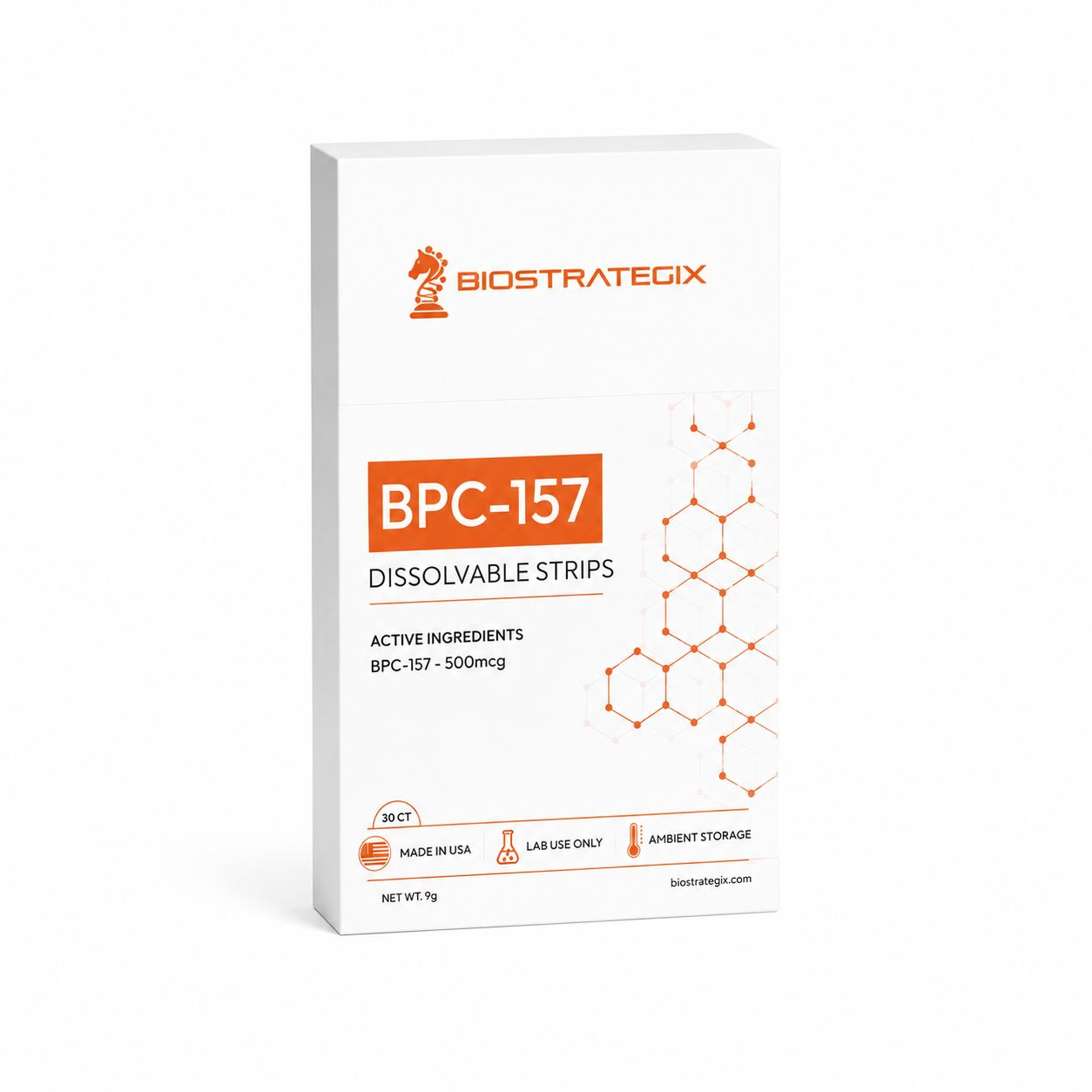
BPC-157 Dissolvable Strips
$85.00
🔥 Exclusive Crypto Offer
Get an INSTANT 15% DISCOUNT when you pay with Bitcoin, Ethereum, Dogecoin, Bitcoin Cash, XRP, Solana, or USDT.
⚡ Don't have crypto? Buy it here in 5 minutes with easy guidance.
💡 Pro Tip: You can also pay with cryptocurrency using your verified Cash App or PayPal account for a fast and secure checkout!
BPC-157 is a synthetic pentadecapeptide with the sequence Gly-Glu-Pro-Pro-Pro-Gly-Lys-Pro-Ala-Asp-Asp-Ala-Gly-Leu-Val and a molecular weight of 1419.55 daltons. It’s a partial sequence of a gastric juice protein, which is where the name body protection compound originates. That gastric origin sets this molecule apart from most research peptides and is precisely why a transmucosal format is worth investigating.
Biostrategix supplies pure BPC-157 in a ready-to-handle, needle-free 30-strip pack with no reconstitution required. Each strip delivers a full 500mcg payload—a 67% dose advantage over competitor blend strips (300mcg)—providing precise, single-compound clarity for dose-dependent research.
What Are BPC-157 Dissolvable Strips?
A BPC-157 dissolvable strip is a thin, water-soluble polymer film labelled at 500mcg of the pentadecapeptide per strip. The film removes the vial, the diluent, and the measurement step that a lyophilized powder requires before any work begins.
Orodispersible films are an established pharmaceutical dosage form. They weigh under 200 mg in total, which reserves the formulation space for potent active ingredients, and are built from film-forming polymers such as pullulan and hypromellose.
A 500mcg payload occupies a very small fraction of a 200 mg film, so the compound is carried comfortably within the polymer matrix. That headroom is what separates a film from a capsule, where the fill volume rather than the matrix sets the limit.
BPC-157 Dissolvable Strip Research Applications
A fixed-content film suits several in vitro workflows directly. Dissolution profiling under standardised conditions, content uniformity across a lot, and stability under controlled temperature and humidity are all measurable on the unit as supplied.
Comparative formulation work is the second application. With mass per unit set at manufacture, a film can be assessed against a reconstituted solution of known concentration without preparation variance entering the comparison.
Analytical method development is the third. A solid dosage form with a defined polymer matrix gives a consistent sample for extraction, recovery, and assay validation work.
Sublingual Delivery & the GI Research Advantage
This is Biostrategix’s biggest content differentiator in the strip market. BPC-157 was originally derived from gastric juice proteins — its foundational research used oral and intragastric administration routes specifically because of its GI relevance.
Sublingual/buccal delivery bypasses hepatic first-pass metabolism and the stomach’s acidic environment, making it the most physiologically relevant non-injectable delivery route for GI mucosal research.
The oral mucosa is well vascularised and drains directly into the systemic circulation, so a compound crossing it avoids hepatic first-pass metabolism. The sublingual epithelium is thin, between 100 and 200 micrometres.
Those are properties of the tissue. What follows sets out the transport parameters that frame BPC-157 sublingual strip research, and the gastric profile that makes this compound an interesting candidate for it.
Transport Parameters for Peptides
The buccal barrier presents an effective pore radius of 1.5 to 3 nm. Compounds above 500 Da permeate at low rates, and most peptides exceed 1000 Da. BPC-157 sits at 1419 Da.
Three further variables govern any peptide held in the oral cavity: mucosal enzyme activity, residence time under salivary flow, and the proportion swallowed rather than absorbed.
For scale, the FDA-approved sublingual desmopressin product documents an absolute bioavailability of 0.25% from an optimised commercial tablet. Those parameters frame the design space rather than close it.
Gastric Stability and the Oral Route
BPC-157 is reported stable in gastric juice beyond 24 hours, which is unusual for a peptide and is the property that made non-injectable routes worth pursuing in animal work.
BPC-157 oral strip gut research follows directly from that property, and much of the rodent work took the same route. A study in 330 rats administered BPC-157 intragastrically or intramuscularly across three ulcer models and reported ulcer inhibition of 45.7% to 65.6%. A rat study of esophagogastric anastomosis used drinking water as one dosing arm.
Transmucosal absorption of BPC-157 remains an open area, and a fixed-content film gives researchers a defined way to approach it. FDA’s 2026 compounding review confirms the oral route has not yet been characterised in humans.
Pure BPC-157 vs Blended Strip Products
This strip contains BPC-157 and the film matrix, with no second active compound. That supports experimental designs where the effect of a single peptide needs to be isolated.
Much of the strip material available elsewhere combines BPC-157 with other actives, most often thymosin beta-4 fragments or copper tripeptides. Any observation made with a multi-compound film is an observation about the mixture.
Single-compound material also keeps the analytical chain simple. One peptide means one identity and purity determination per lot, and the certificate for that lot describes the entire active content of the film.
500mcg Dose — Why It Matters for Research
Each strip is labelled at 500mcg of BPC-157. That figure is the specification and the number a researcher starts any calculation from, with measured content for a given lot established by that lot’s certificate of analysis.
Strength per unit is where strips differ most from vials. A lyophilized vial’s working concentration depends on how much diluent is added and how accurately it is measured, so two researchers working from identical vials can arrive at different concentrations.
A film sets that during manufacture, which moves the variable upstream to where lot testing rather than bench technique is the control. That is the practical distinction between a strip and a bench-prepared injection.
BPC-157 Strip vs Injection Research
BPC-157 sublingual vs injectable comparisons come down to where the concentration is set. A film fixes it at manufacture; a vial fixes it at the bench.
Strip material elsewhere in this category is frequently built at lower BPC-157 content and as part of a blend, so a 500mcg single-compound film is both a higher payload and a simpler one for comparative work.
The 30-Strip Format
For BPC-157 30-strip research, a single pack gives one lot across an extended working period, which keeps lot-to-lot variation out of a sequence of related experiments. Each unit is individually sealed, so the remainder of the pack is unaffected by the opening of any one strip. Oral BPC-157 no reconstitution handling is the practical difference from a vial.
Certificate of Analysis & Purity Documentation
Biostrategix publishes third-party certificates of analysis for its catalogue in the Certificates of Analysis library, with testing by MDx Biolabs, MZ Biolabs and Zyntro Analytical Lab Solutions, and separate endotoxin testing on many entries.
A BPC-157 strip COA verified by a named third-party laboratory is uncommon in this category. Most films sold as research material carry no public purity testing, which leaves the buyer with a product name and nothing to verify it against.
FDA’s 2026 review of BPC-157 as a compounding substance notes that its chemical characterisation is still developing, which places the value squarely on supplier-side testing.
Storage & Handling
Store sealed strips in a cool, dry place away from direct light, and keep the pouch closed until a strip is required. Film dosage forms are moisture-sensitive by design, since the property that makes them disintegrate on contact with water also makes them responsive to ambient humidity.
Humidity control preserves both the physical integrity of the film and the stability of what it carries. Record lot number, receipt date and storage conditions alongside experimental data, since film stability over time in a laboratory environment is not yet characterised for this compound.
Related Formats in the Catalogue
The same compound is supplied in vial format as BPC-157 lyophilized powder, and as BPC-157 with arginine salt for work where solubility characteristics matter. For combination work, BPC-157 with TB-500 is available in vial format, and the same pairing is offered as a dissolvable strip.
Comparing a film against a vial of the same compound is the most direct way to characterise what the format contributes, since the molecule is held constant across both.
Buy BPC-157 Oral Strip Peptide
Biostrategix stocks the pure BPC-157 strip for sale in a 30-strip pack, shipped from California, with orders typically dispatched within 48 hours.
Certificates of analysis for the catalogue are published openly, and lot documentation is available on request against the lot number printed on the pouch.
Order the BPC-157 500mcg dissolvable strip from Biostrategix.
Frequently Asked Questions
What is BPC-157?
BPC-157 is a synthetic pentadecapeptide, molecular weight 1419.55 daltons, and a partial sequence of a protein found in human gastric juice. It is supplied as a research material.
What does the research record cover?
The preclinical record is substantial. Rodent studies span gastric ulcer models, gastrointestinal anastomosis, myotendinous junction defects and muscle crush injury, with several using intragastric or drinking-water administration. Human research is at an earlier stage, with a small number of clinical studies published to date. The preclinical base is the developed part of the record and the clinical base is still forming.
BPC-157 Oral vs Injectable Bioavailability
Transport across the oral mucosa is governed by molecular size, enzyme activity and residence time. Compounds above 500 Da permeate at low rates, and reported figures for peptides delivered buccally or sublingually sit in the range of 1 to 2 percent. Transmucosal absorption of BPC-157 specifically has not yet been quantified, which is what makes the format a research question in its own right.
BPC-157 Strip vs Capsule Research
A film and a capsule differ in where the active sits. A film carries the compound in a thin polymer matrix; a capsule carries it in a fill whose volume sets the limit. No published work compares the formats for this compound, so any comparison beyond handling is outside the current evidence.
Sublingual BPC-157 Gut Research
Because of its origin and its behaviour. It is a partial sequence of a human gastric juice protein, is reported stable in gastric juice beyond 24 hours, and a large share of the rodent literature used intragastric or drinking-water administration.
What documentation comes with this material?
Third-party identity and purity testing is published in the Biostrategix certificates of analysis library. Certificates are batch-specific, so confirm one exists for the lot and format received.
How Does Oral BPC-157 Work?
BPC-157 is Gly-Glu-Pro-Pro-Pro-Gly-Lys-Pro-Ala-Asp-Asp-Ala-Gly-Leu-Val, fifteen residues with a molecular weight of 1419.55 daltons. Its reported stability in gastric juice beyond 24 hours is what made non-injectable routes worth pursuing. By the oral route in rodent models the compound was administered intragastrically or in drinking water, which is the body of work the format question builds on.
What in vitro work does this format support?
Dissolution profiling, content uniformity assessment and stability testing under controlled temperature and humidity are all measurable on the unit as supplied. The format also suits comparative formulation studies against a reconstituted solution, and analytical method development where a consistent solid matrix is useful.
How should a lot be verified on receipt?
Match the lot number printed on the pouch against the certificate for that lot, and confirm the certificate covers the strip format rather than another dosage form. Check identity, purity and content as three separate determinations, then record the lot number and receipt date alongside the experimental data.
What does the 30-strip pack contain?
Thirty individually sealed films, each labelled at 500mcg of BPC-157, drawn from a single manufacturing lot. A single lot across the pack keeps lot-to-lot variation out of any sequence of related experiments, and individual sealing means the remainder is unaffected as units are drawn.
How does the strip compare with the vial listing of the same compound?
The molecule is identical. What differs is that the film arrives with content set at manufacture, while a vial prepared for injection requires reconstitution to a concentration the researcher determines. Running the two alongside each other is the most direct way to characterise the contribution of the format itself.
Legal Disclaimer
These products are intended as research materials only.
This designation allows the use of research chemicals strictly for in vitro testing and laboratory experimentation only. All product information available on this website is for educational purposes only. Bodily introduction of any kind into humans or animals is strictly forbidden by law and is not endorsed by this website. This product should only be handled by licensed, qualified professionals. This product is not a drug, food, or cosmetic and may not be misbranded, misused, or mislabeled as a drug, food, or cosmetic.
| Amount | BPC-157 500mcg each (30 Strips) |
|---|
Only logged in customers who have purchased this product may leave a review.
Related products
Home page
Home page
Home page
Home page
Fall Flash Sale
Fall Flash Sale
Home page
Home page
Reviews
There are no reviews yet.