
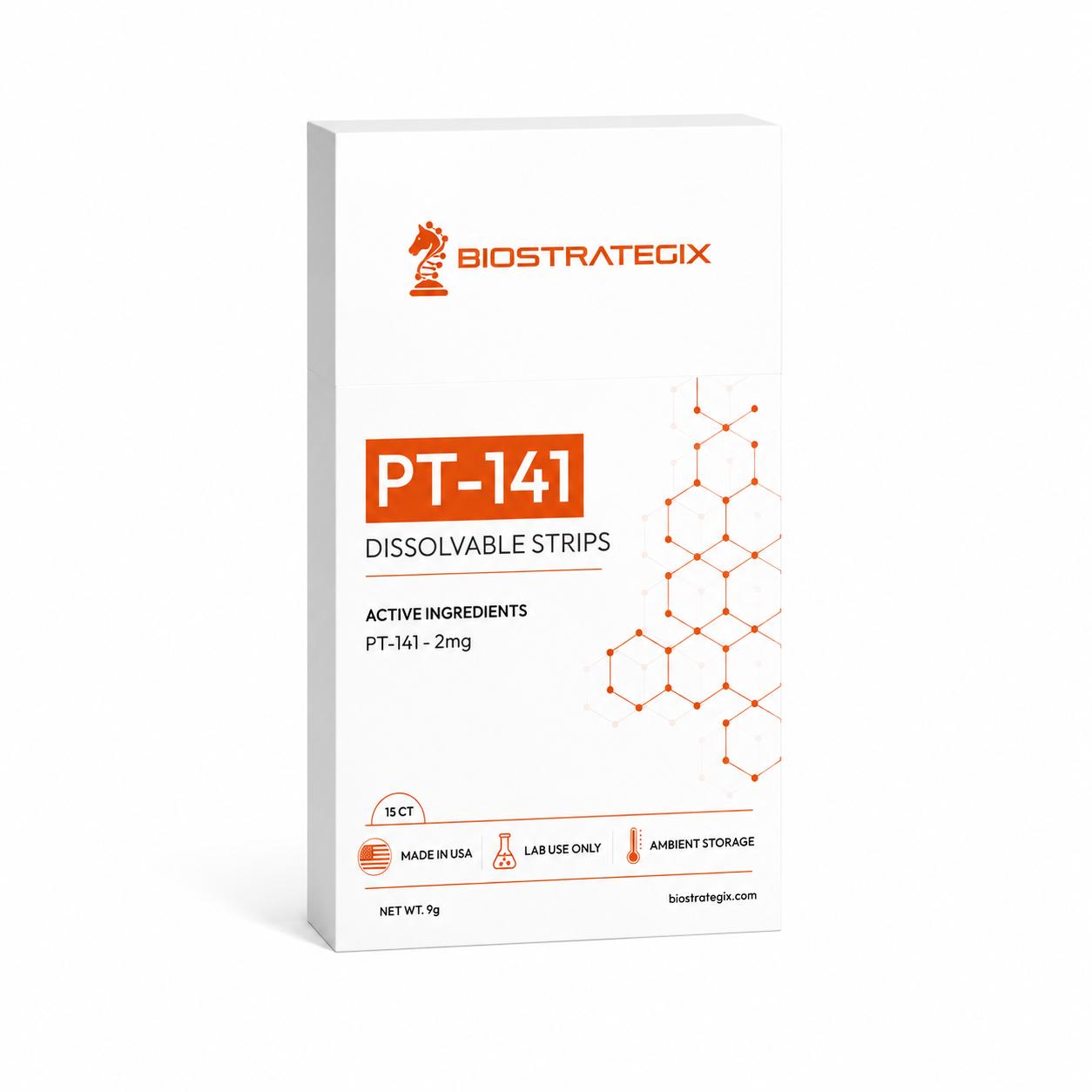
PT-141 Dissolvable Strips
$150.00
🔥 Exclusive Crypto Offer
Get an INSTANT 15% DISCOUNT when you pay with Bitcoin, Ethereum, Dogecoin, Bitcoin Cash, XRP, Solana, or USDT.
⚡ Don't have crypto? Buy it here in 5 minutes with easy guidance.
💡 Pro Tip: You can also pay with cryptocurrency using your verified Cash App or PayPal account for a fast and secure checkout!
PT-141 is bremelanotide, a synthetic melanocortin receptor agonist. FDA’s chemistry review describes it as a synthetic cyclic heptapeptide with a molecular weight of 1025.2 as the free base, and NIH’s drug monograph describes it as an analogue of alpha-MSH.
At Biostrategix, we supply the PT-141 2mg strip research format as a single compound, with no second active. Offered as a needle-free PT-141 research peptide, it is among the smaller peptides in this catalogue at 1025 Da across seven residues.
What Are PT-141 Dissolvable Strips?
A PT-141 dissolvable strip is a thin, water-soluble polymer film labelled at 2mg of bremelanotide per strip. PT-141 oral dissolving film research uses the same unit as supplied, with no vial, no diluent and no measurement step of the kind a lyophilized powder requires. PT-141 tongue strip research is the common shorthand for the same format, since the film is placed under the tongue.
Film Format and Composition
Orodispersible films are an established pharmaceutical dosage form. They weigh under 200 mg in total, which reserves the formulation space for potent active ingredients, and are built from film-forming polymers such as pullulan and hypromellose.
Measured content for a given lot comes from that lot’s certificate of analysis, and this product has strip-specific testing behind it.
Receptor Pharmacology
PT-141 is characterised as an agonist at MC3R and MC4R, which are expressed primarily in the central nervous system, and reports that in rats it activated hypothalamic neurons. The FDA-approved label for the bremelanotide product states that it activates several receptor subtypes, in order of potency MC1R, MC4R, MC3R, MC5R and MC2R.
Sublingual Peptide Strip Research Applications
- A fixed-content film suits several in vitro workflows directly. Dissolution profiling under standardised conditions, content uniformity across a lot, and stability under controlled temperature and humidity are all measurable on the unit as supplied.
- Comparative formulation work is the second application. With mass per unit set at manufacture, a film can be assessed against a reconstituted solution of known concentration without preparation variance entering the comparison.
- Analytical method development is the third. A solid dosage form with a defined polymer matrix gives a consistent sample for extraction, recovery and assay validation work.
Sublingual Delivery vs Injectable Format
PT-141 sublingual strip research differs from injectable work in preparation and documentation rather than in the molecule. A film arrives with content set at manufacture, while a lyophilized vial requires diluent, measurement and management of a reconstituted solution.
PT-141 no reconstitution research is the practical consequence: the unit is used as supplied.
The oral mucosa is well vascularised and drains directly into the systemic circulation, so a compound crossing it avoids hepatic first-pass metabolism, and the sublingual epithelium is thin, between 100 and 200 micrometres.
Transport Parameters
The buccal membrane presents an effective pore radius of 1.5 to 3 nm, and compounds above 500 Da permeate at low rates. Mucosal enzyme activity and residence time under salivary flow are the further variables.
At 1025 Da across seven residues, bremelanotide sits at the favourable end of that range for a peptide, which makes it a more interesting mucosal candidate than most compounds in this category.
Reported bioavailability for peptides delivered buccally or sublingually sits around 1% to 2%, and the FDA-approved sublingual desmopressin product documents 0.25 percent at close to this molecular size.
Route History for This Compound
A non-injectable formulation of this compound was developed and taken into human trials. A double-blind, placebo-controlled study of intranasal PT-141 in healthy men and men with erectile dysfunction reported a response above 7 mg.
A later phase 2b programme in 397 women incorporated intensive monitoring following FDA feedback on the intranasal studies.
The product that reached market is a subcutaneous autoinjector, which means transmucosal delivery of this compound remains an open area and a defined one to work in.
Permeation Enhancers
Sodium caprate temporarily opens intercellular tight junctions and increases membrane fluidity, performing comparably to the established benchmark in the gastrointestinal work reporting it.
Cyclodextrins act primarily as solubilisers, carrying a compound to the membrane surface where the complex dissociates.
Both remain active areas of formulation research, and a compound at the smaller end of the peptide range is a reasonable place to explore them.
Pure PT-141 vs Blended Strip Products
Pure PT-141 strip vs blend is the core distinction here. This film contains bremelanotide and the polymer matrix, with no second active compound, which supports work on melanocortin receptor pharmacology in isolation.
Unlike most strip-format PT-141 products on the market, which are blends combining PT-141, Oxytocin, and Aminophenylpyrrole, Biostrategix provides a strip containing pure PT-141 only. This single-active formulation allows researchers to study the specific MC3R and MC4R mechanism in isolation, eliminating confounding variables from additional active compounds.
With a single compound rather than a blend, an effect can be attributed to MC3R or MC4R engagement rather than to a co-formulated active, and there is a clean comparison to the injectable record.
Identity and the Single-Compound Chain
Bremelanotide is structurally related to other melanocortin agonists in circulation, so a product name alone is not an identity determination.
Single-compound material keeps the analytical chain short: one peptide means one identity and purity determination per lot, and the certificate for that lot describes the entire active content of the film.
Molecular Size in Context
At 1025 Da across seven residues, bremelanotide is smaller than most peptides supplied in this format. The pentadecapeptides in the recovery range sit near 1419 Da and the GLP-1 class compounds are several times larger again.
Transport across the oral mucosa is size-dependent, so position within that range is the first parameter any transmucosal study would account for.
Molecular size is one input among several, alongside enzyme activity and residence time, but it is the one that differs most across this catalogue.
Certificate of Analysis & Purity Documentation
Certificates are published in the Certificates of Analysis library. Reported purity was 98.36 percent against a specification of greater than 98 percent, so this is a PT-141 strip COA verified on the finished format.
Purity and content are separate determinations. Purity reports what proportion of the material is the target molecule; content reports the mass present. Both laboratories quantified content per strip, so researchers should take the measured figure for their lot from the certificate rather than from the label.
Certificates are batch-specific, so confirm which lot has been received before relying on any figure.
Storage & Handling
Sealed strips are room temperature stable and should be stored in a cool, dry place away from direct light. Keep the pouch closed and avoid exposing strips to moisture, using each strip promptly once opened. The property that makes a film disintegrate on contact with moisture also makes it responsive to ambient humidity.
Humidity control preserves both physical integrity and the stability of the compound carried. Record lot number, receipt date and storage conditions alongside experimental data, since stability of bremelanotide in film format over time is not yet characterised.
Related Formats in the Catalogue
The same compound is supplied in vial format as PT-141 lyophilized powder, which is the comparator for any work characterising what the film contributes.
Related melanocortin and neuropeptide material in the catalogue includes MT1 and MT2, both melanocortin agonists with different receptor selectivity profiles.
Holding the molecule constant and varying only the format is the cleanest way to isolate what a film changes.
Buy PT-141 Strip Peptide
Biostrategix stocks the PT-141 strip for sale, shipped from California, with orders typically dispatched within 48 hours.
Strip-specific certificates of analysis are published openly, and lot documentation is available on request against the lot number printed on the pouch.
Order the PT-141 2mg dissolvable strip from Biostrategix.
Frequently Asked Questions
How does sublingual peptide delivery work?
The oral mucosa is well vascularised and drains directly into the systemic circulation, so a compound crossing it avoids hepatic first-pass metabolism. Molecular size, mucosal enzyme activity and residence time govern how much crosses. PT-141 is a synthetic cyclic heptapeptide of 1025.2 Da acting at melanocortin receptors including MC3R and MC4R, which places it at the smaller end of the peptide range for this route.
What did the pivotal trials report?
Two identical 24-week phase 3 randomised, double-blind, placebo-controlled trials in 1,267 premenopausal women reported statistically significant improvements against placebo on the desire and distress measures used.
What in vitro work does this format support?
Dissolution profiling, content uniformity across a lot and stability testing under controlled temperature and humidity are all measurable on the unit as supplied.
Because this product has strip-specific third-party testing behind it, measured content and purity for the supplied format are already documented rather than inferred from a powder lot.
How should a lot be verified on receipt?
Match the lot number printed on the pouch against the certificate for that lot, and confirm the certificate covers the strip format.
Identity, purity and content are three separate determinations, and both laboratories reported all three for the August 2026 batch.
Why does molecular size matter for this compound?
Transport across the oral mucosa is size-dependent, with permeation falling as molecular weight rises above roughly 500 Da.
At 1025 Da across seven residues, bremelanotide is among the smaller peptides supplied in this format, which places it at the more favourable end of the range for transmucosal research.
How does the strip compare with the vial listing of the same compound?
The molecule is identical. The film arrives with content set at manufacture, while the vial requires reconstitution to a concentration the researcher determines. Running the two alongside each other is the most direct way to characterise what the format contributes.
Legal Disclaimer
These products are intended as research materials only.
This designation allows the use of research chemicals strictly for in vitro testing and laboratory experimentation only. All product information available on this website is for educational purposes only. Bodily introduction of any kind into humans or animals is strictly forbidden by law and is not endorsed by this website. This product should only be handled by licensed, qualified professionals. This product is not a drug, food, or cosmetic and may not be misbranded, misused, or mislabeled as a drug, food, or cosmetic.
| Amount | 2 MG each (15 Strips) |
|---|
Only logged in customers who have purchased this product may leave a review.
Related products
Home page
Home page
Fall Flash Sale
Home page
Home page
Home page
Home page
Home page
Reviews
There are no reviews yet.