
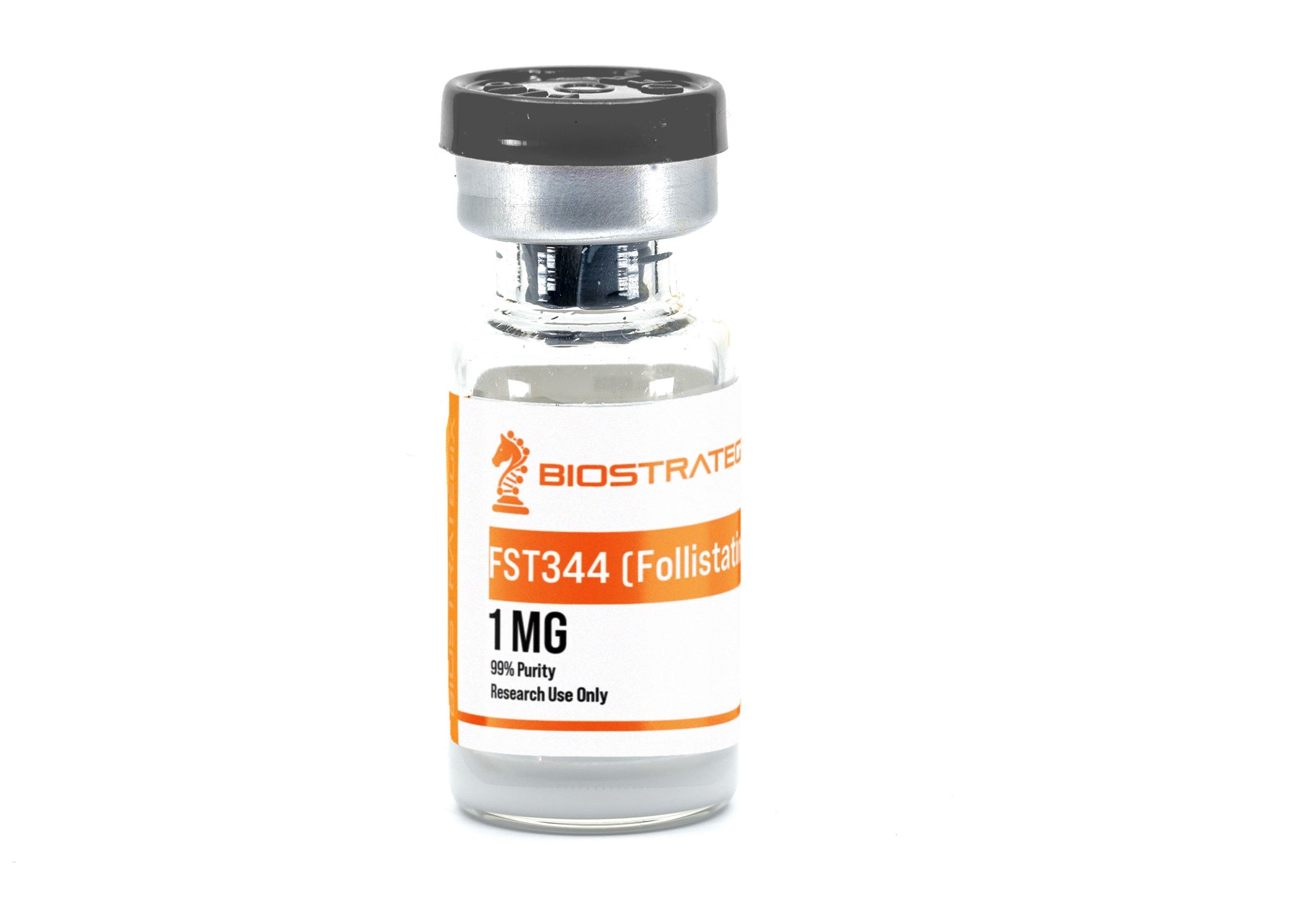
Follistatin 344
Price range: $90.00 through $405.00
🔥 Exclusive Crypto Offer
Get an INSTANT 15% DISCOUNT when you pay with Bitcoin, Ethereum, Dogecoin, Bitcoin Cash, XRP, Solana, or USDT.
⚡ Don't have crypto? Buy it here in 5 minutes with easy guidance.
💡 Pro Tip: You can also pay with cryptocurrency using your verified Cash App or PayPal account for a fast and secure checkout!
Follistatin 344 is named for the 344-residue precursor of human follistatin, a secreted glycoprotein that binds and neutralizes myostatin and activin. At Biostrategix, we list Follistatin 344 1mg as a lyophilized research vial for in vitro and laboratory work.
Follistatin sits at the center of myostatin research. Its record spans protein chemistry, crystal structures, transgenic mice and gene-transfer studies in mice and a small human cohort.
We supply Follistatin 344 strictly as a research material, investigational and with no approved indication.
What Is Follistatin 344?
Follistatin 344 refers to the full-length human follistatin precursor, 344 amino acids including a 29-residue signal peptide. Removal of that signal peptide gives the mature 315-residue protein, FS-315, which binds activin and myostatin and blocks their receptor-binding sites.
The UniProt record for human follistatin lists the 344-residue precursor at 38,007 daltons, with the mature chain running from residue 30 to 344. The same entry records two N-linked glycosylation sites, 18 disulfide bonds and a disordered, acidic C-terminal tail.
The Follistatin-344 peptide and FST-344 peptide names therefore describe a protein precursor, not a short peptide. The mature polypeptide is about 34.8 kDa before glycosylation, calculated from the UniProt sequence.
Domain Structure
Follistatin is built from an N-terminal domain followed by three follistatin domains, each pairing an EGF-like and a Kazal-like module. The acidic tail at the C-terminus is the part that separates the long and short isoforms.
That modular structure matters for binding. Whole follistatin is needed to bind myostatin, and single follistatin modules do not bind on their own.
Follistatin 344 vs Follistatin 315: Key Differences for Research
Follistatin 344 vs 315 is a precursor-versus-mature distinction, not a choice between two products. FS-344 is the translated precursor, and FS-315 is the same protein after its 29-residue signal peptide is removed.
The isoforms come from alternative splicing. A 1988 study cloning human follistatin cDNA found clones predicting a 344-residue precursor and a 317-residue precursor, which mature into FS-315 and FS-288 respectively.
FS-315 and FS-288 differ by a 27-residue acidic C-terminal extension. That extension is the main structural difference between the two mature forms.
Molecular Weights of the Forms
The 344-residue precursor is 38,007 daltons. Calculated from the UniProt sequence, the unglycosylated mature FS-315 polypeptide is about 34.8 kDa and FS-288 about 31.6 kDa.
Glycosylation adds mass on top of those polypeptide figures, and the amount depends on the expression system. Mass spectrometry on a lot certificate is what confirms the form actually supplied.
Cell-Surface and Heparin Binding
The extension changes how follistatin associates with cells. A 1993 study of follistatin molecular forms of porcine follistatin reported that FS-288 bound heparan sulfate and rat granulosa cell surfaces, while FS-315 did not, though all forms bound activin with nearly the same affinity, Kd 540 to 680 pM.
Later structural work added nuance. Heparin affinity of the two forms is similar at low ionic strength, and FS-315 bound to activin binds heparin as FS-288 does.
Why FS-344 Became the Research Standard
FS-344 is the construct most used in gene-transfer studies. A 2008 study of myostatin inhibitor gene transfer states that FS-344 is cleaved to FS-315, and that the authors chose it to avoid the FS-317 and FS-288 form, whose heparan sulfate binding drives tissue localization and possible off-target binding.
Myostatin Inhibition: How Follistatin 344 Works in Animal Models
Follistatin myostatin inhibition works by binding the ligand, not the receptor. Two follistatin molecules wrap around myostatin and block its receptor-binding sites, so myostatin cannot engage activin receptor type IIB.
The Follistatin 344 mechanism ActRIIB link is therefore indirect. A 2001 study of myostatin receptor binding reported that purified myostatin bound ActRIIB with a Kd of about 10 nM, and that follistatin inhibited that binding.
The structure shows how. A 2009 crystal structure of myostatin with follistatin found that two FS-288 molecules completely surround the ligand and block all four receptor-binding sites, and that complex formation raised heparin affinity.
Ligand Specificity
Myostatin is not follistatin’s only ligand. Follistatin also neutralizes activin, GDF11 and some bone morphogenetic proteins, and in the activin complex two follistatin molecules encircle the ligand and bury about a third of its residues.
In that structure, the follistatin N-terminal domain occupies the type I receptor site as well. Follistatin therefore blocks both type I and type II receptor engagement, which is why it reads as a ligand trap rather than a receptor antagonist.
Transgenic Mouse Models
Transgenic mice provided an early in vivo picture. In the 2001 study, mice expressing a follistatin transgene in muscle showed quadriceps weights of 421 and 736 mg in two founder animals, against 251.7 mg in controls. The authors reported the larger increase as significantly greater than those seen in myostatin-null mice.
The myostatin knockout itself defines GDF-8 biology. Myostatin-null mice carry individual muscles two to three times heavier than wild type.
Gene Transfer in Mice and Humans
The FS-344 gene has been delivered by AAV vector in mice and in humans. In mice, the 2008 study reported increased muscle mass and grip strength at 725 days in normal animals and increased strength with reduced serum creatine kinase in mdx mice.
In humans, a 2015 phase 1/2a gene-transfer trial delivered AAV1.CMV.FS344 to the quadriceps of six men with Becker muscular dystrophy. Six-minute walk distance rose by 58 and 125 meters in two of three men in the first cohort and by 108 and 29 meters in two of three in the second, with no adverse effects reported.
These are gene-transfer studies, in which cells produce follistatin from a delivered gene. None of the studies above tested a supplied follistatin protein in the same models.
Follistatin 344 in Muscle Differentiation and Satellite Cell Research
Follistatin 344 muscle research extends from whole animals to differentiating cells. In culture, follistatin binds myostatin directly and rescues myogenic differentiation, and in mice its effect on muscle depends partly on satellite cell proliferation and partly on activin.
The in vitro work established direct binding. A 2004 study of follistatin and myostatin complexes measured an affinity of 5.84 x 10^-10 M and reported that follistatin blocked myostatin’s suppression of Pax-3 and MyoD and rescued differentiation in chick limb mesenchyme cultures in a concentration-dependent way.
That study also found that whole follistatin was required. Single follistatin modules did not bind myostatin.
Follistatin Satellite Cell Research
Follistatin satellite cell research tested how much of the effect runs through muscle stem cells. A 2009 mouse study of follistatin hypertrophy reported muscle weight up about 37 percent with follistatin overexpression, but only about 20 percent when satellite cell proliferation was blocked by irradiation.
The same study separated myostatin from activin. Follistatin produced the same hypertrophy in myostatin-knockout and wild-type mice, while a mutant with low activin affinity produced 14 percent against 32 percent and none in knockouts.
Beyond Myostatin
A 2007 study combining follistatin and myostatin loss found that a follistatin transgene on a myostatin-null background roughly quadrupled muscle mass, against roughly double for myostatin loss alone in that study. The author concluded that other regulators of muscle mass with myostatin-like activity exist, which makes follistatin a broader tool than a myostatin inhibitor peptide research reagent alone.
Follistatin 344 Reconstitution and Solution Handling
Follistatin 344 reconstitution differs from short-peptide work because the material is a disulfide-rich protein. Its 18 disulfide bonds, two glycosylation sites and heparin-binding surface all shape how a solution behaves in an in vitro assay.
The expression system sets the glycosylation state. Recombinant FS-315 and FS-288 have been expressed in Chinese hamster ovary cells, and engineered changes to glycosylation and to the heparin-binding loop changed exposure in mice tenfold to twentyfold, so glycosylation is a property worth recording for each lot.
Assay Conditions in Published Binding Studies
Follistatin binds heparin and heparan sulfate, so heparin-containing reagents and cell-surface proteoglycans in an assay system compete for it. Receptor-binding studies with follistatin and myostatin have run in phosphate-buffered saline with 1 mg/mL bovine serum albumin as a carrier protein.
Buffer, carrier and concentration follow the assay design. Each prepared solution is logged against the lot number.
Certificate of Analysis and Purity Documentation
At Biostrategix, we have not yet posted a certificate of analysis for Follistatin 344. Identity, purity and expression system are the measurements a lot certificate for this compound documents, in line with the certificates posted for the rest of our catalog.
We do not quote a Follistatin 344 COA purity 95% figure, or any other purity figure, until a certificate for the lot is posted. Our third-party certificates of analysis library lists every compound with a current certificate.
What a Protein Certificate Covers
A certificate for a protein of this size carries more than a peptide certificate. Identity by mass, purity by HPLC and, for a glycoprotein, the glycosylation state are the measurements that define a lot.
Storage and Handling
Follistatin 344 is supplied as a lyophilized solid and stored desiccated and frozen. The dry vial is the stable form, and a prepared solution is treated as a separate material with its own preparation date.
The material stays sealed until an assay calls for it. Cationic peptides at low concentration have shown large losses to glass and plastic surfaces, and published binding assays with follistatin used carrier protein in the buffer, so dilute solutions are best prepared close to the point of measurement.
Each vial is tracked against its lot number from receipt. That record links every in vitro reading to the documented batch.
Related Muscle Research Peptides
GDF-8 Follistatin research pairs the ligand with its binding protein. At Biostrategix, we stock both, along with other growth factor research compounds, so a binding or neutralization assay can draw its components from documented catalog material.
Our GDF-8 myostatin research vial in 1mg supplies the ligand that follistatin neutralizes. Our IGF LR3 receptor grade research vial covers a separate growth factor pathway.
The full range sits in our full peptides and more research catalog. Follistatin 344 and GDF-8 are both grouped with our newest research peptides added to catalog.
Buy Follistatin 344
At Biostrategix, we list Follistatin 344 1mg as a lyophilized research vial at $90.00 for a single vial and $405.00 for a five-pack. Both options are out of stock as of October 2026, and the listing carries both pack sizes for the next lot.
Orders ship within 48 hours by USPS Priority or Express from California. Every Follistatin 344 for sale on our site is supplied as the research peptide Follistatin 344 for laboratory use only.
Check the Follistatin 344 listing for the next lot.
Frequently Asked Questions
What is Follistatin 344?
Follistatin 344 is the 344-residue precursor of human follistatin, a glycoprotein that binds and neutralizes myostatin and activin. Removing its 29-residue signal peptide gives the mature FS-315 protein.
What is the difference between Follistatin 344 and 315?
FS-344 is the precursor and FS-315 is the mature protein after signal-peptide removal. They are the same protein at two stages, while FS-288 is a shorter form from a separate splice variant.
How does follistatin inhibit myostatin?
Two follistatin molecules surround the myostatin dimer and block its receptor-binding sites. Myostatin then cannot bind activin receptor type IIB.
Has Follistatin 344 been studied in humans?
Only as a gene. A phase 1/2a trial delivered the FS-344 gene by AAV vector to six men with Becker muscular dystrophy, and none of the human studies we found used follistatin protein.
Is Follistatin 344 a peptide or a protein?
It is a protein. The mature form is 315 amino acids with 18 disulfide bonds and two glycosylation sites, far larger than the short peptides in most research catalogs.
Is there a COA for Follistatin 344?
Not yet. We post certificates by lot, and we state no purity figure for this compound until a lot certificate is published.
What is the regulatory status of follistatin?
Follistatin is not an approved drug, and it does not appear on FDA’s list of compounding safety-risk substances. The World Anti-Doping Agency names follistatin as a myostatin-binding protein prohibited at all times.
All products are sold for research, laboratory, and analytical purposes only. Not for human or animal consumption. These statements have not been evaluated by the FDA.
| Amount | 1MG – Five Pack, 1MG – Single |
|---|
Only logged in customers who have purchased this product may leave a review.
Related products
Home page
Home page
Home page
Christmas Sale
Home page
Home page
Home page
Fall Flash Sale
Reviews
There are no reviews yet.